

Key Elements of a Persuasive Business Presentation for Influencing Stakeholders
Every high-stakes meeting offers the same invisible test: can you move decision-makers from passive listening to committed action? A persuasive business presentation is a structured communication designed to change stakeholder beliefs, attitudes, or behaviors by combining credibility, emotion, and logic. Whether you are pitching a new initiative, defending a budget, or aligning leadership around a strategy, the elements you build into your presentation determine whether your ideas gain traction or stall. In this guide, we break down the core components that separate forgettable slide decks from presentations that drive real decisions.
1. Establish Credibility From the First Moment
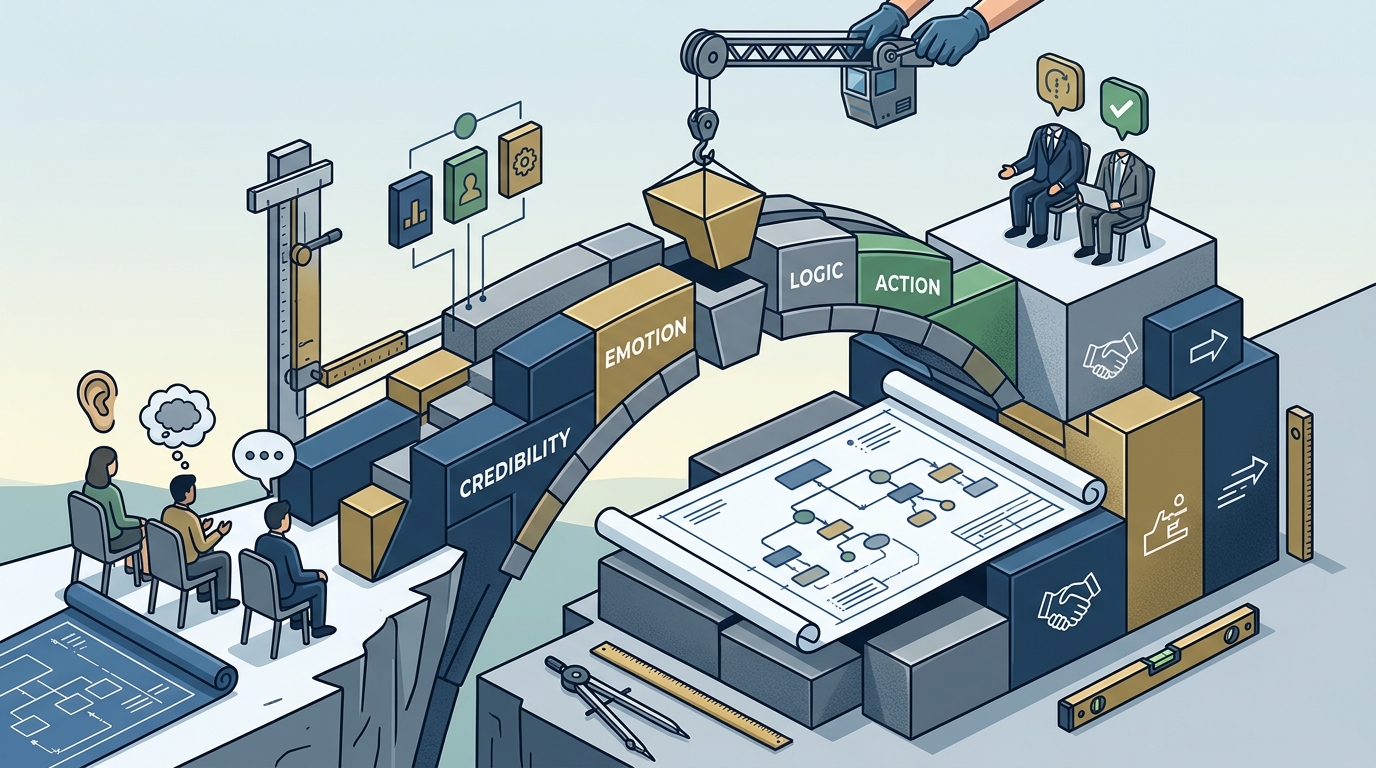
Aristotle identified three modes of persuasion over 2,300 years ago: ethos, pathos, and logos. Ethos is the appeal to a speaker's credibility, and it remains the foundation of every persuasive business presentation. If stakeholders do not trust the presenter, no amount of data will move them.
Research into leadership decision processes suggests that within seconds of your opening, executives form a subconscious judgment about your strategic value. That initial impression shapes how every subsequent point is processed. Open with a sharp point of view, reference relevant experience, and frame the context before diving into details. This positions you as a navigator rather than a reporter.
Quick Credibility Builders
- Lead with a brief, relevant result or case study your audience can verify.
- Use industry-specific language that signals expertise without creating jargon overload.
- Cite recognized sources and data points rather than vague claims.
2. Know Your Stakeholders Inside and Out
Stakeholder analysis is the process of identifying what your audience cares about, what they fear, and what will motivate them to act. Every persuasive presenter customizes the message to the room. A CFO wants financial impact; a CTO wants feasibility; a CEO wants strategic alignment.
A speaker's ability to adapt their delivery, reflecting a keen sense of the audience's needs, often distinguishes an adequate presentation from an outstanding one. Tapping into shared business interests ensures your message sustains connection throughout the talk. Before you build a single slide, map each stakeholder's priorities, objections, and decision criteria.
Stakeholder Mapping Framework
- Identify: Who are the decision-makers, influencers, and blockers?
- Prioritize: Which concerns carry the most weight in the room?
- Align: Tailor your opening, evidence, and ask to match those priorities.
3. Structure Your Message for Clarity and Impact
Great ideas fail when they are not organized clearly. Business presentation skills training consistently shows that clarity of structure is the single biggest lever for persuasion. A persuasive presentation follows a deliberate architecture: a compelling opening, a logically sequenced body, and a decisive close.
A presentation's success hinges on the clear articulation of ideas, structured neatly into an introduction, body, and conclusion. The introduction frames the problem and stakes. The body delivers evidence in digestible sections. The conclusion moves stakeholders toward a specific decision or next step. Without this architecture, even brilliant insights get lost in noise.
The Problem-Solution-Impact Model
- Problem: State the business challenge in terms stakeholders feel.
- Solution: Present your recommendation with supporting evidence.
- Impact: Quantify the outcome and connect it to organizational goals.
Developing strong content organization serves as the backbone of any persuasive business case.
4. Use Storytelling to Make Data Memorable
Storytelling in business presentations is the practice of weaving data and evidence into a narrative arc that audiences can follow emotionally and logically. Modern audiences remember stories, not bullet points. When your narrative echoes the audience's experiences or challenges, it transforms a one-way transmission into an engaging dialogue.
Case studies and real-world examples add a human element, making abstract concepts tangible and relatable. They evoke emotion and create deeper connection, enhancing both memorability and persuasion. Framing a business case as a journey, where the company faces a challenge, implements a solution, and achieves measurable success, is far more compelling than a list of features.
Data does not persuade on its own; context does. Professionals who need their numbers to drive decisions benefit from learning storytelling with data techniques that translate raw figures into strategic narratives.
5. Design Visuals That Reinforce, Not Distract
Most professionals were never taught how to build an effective business slide deck. As a result, presentations often become overloaded, hard to follow, and too dependent on the screen. When a deck looks busy, the audience loses confidence fast.
Clearer structure, cleaner visuals, and more intentional slide choices increase confidence, strengthen authority, and make the message easier to absorb. Each slide should answer one question or reinforce one key point. Replace paragraphs of text with a single headline and supporting visual. The Winning Slide Decks Masterclass from Effective Presentations teaches professionals to build slides that work harder in meetings, pitches, and leadership updates.
Slide Design Principles
- One message per slide.
- Use visuals (charts, images, icons) to replace text wherever possible.
- Maintain consistent branding and font hierarchy.
- Highlight the single data point you want stakeholders to remember.
6. Deliver With Executive Presence
Executive presence is not about personality or style. It is about how you are perceived when you speak. The most persuasive presenters combine vocal authority, purposeful body language, and composed confidence under pressure.
Varying your tone keeps the audience engaged, while controlling the pace of speech allows for better comprehension. Strategic pausing after key points creates emphasis and gives stakeholders time to process. Non-verbal cues, including eye contact, open gestures, and grounded posture, communicate conviction before you say a word.
Professionals preparing for high-stakes moments can sharpen these skills through executive presence training that focuses on the psychology of influence and audience engagement. Effective Presentations has spent more than 20 years helping professionals nationwide communicate with clarity, confidence, and persuasion.
7. Comparing Persuasion Frameworks: Aristotle to Modern Methods
Understanding which framework to apply helps you choose the right persuasive strategy for each stakeholder scenario. Below is a comparison of classical and modern approaches.
| Framework | Core Principle | Best For | Key Tactic |
|---|---|---|---|
| Aristotle's Rhetoric (Ethos, Pathos, Logos) | Credibility + Emotion + Logic | General stakeholder persuasion | Balance all three appeals in every presentation |
| Problem-Solution-Impact | Structured narrative arc | Budget approvals, project proposals | Lead with the pain point, close with quantified ROI |
| Cialdini's Principles of Influence | Social proof, reciprocity, scarcity | Sales presentations, executive buy-in | Show peer adoption, highlight time-sensitive opportunity |
| Cognitive Authority Framework | Immediate strategic positioning | C-suite and board presentations | Frame context in the first 15 seconds |
| Minto Pyramid Principle | Answer-first communication | Consulting, executive summaries | State recommendation before supporting evidence |
The most effective presenters blend these frameworks depending on audience, stakes, and objective. Training programs like those from Effective Presentations teach participants how to adapt their approach to each situation.
Key Takeaways
- Credibility (ethos) must be established in the opening seconds of any stakeholder presentation.
- Stakeholder analysis before the presentation is as important as the presentation itself.
- Clear message structure, using a problem-solution-impact model, keeps audiences focused and drives decisions.
- Storytelling transforms data from forgettable statistics into persuasive narratives.
- Slide design should reinforce one message per slide; cluttered visuals erode trust.
- Executive presence, including vocal variety, strategic pausing, and confident body language, amplifies every other element.
- Blending classical persuasion frameworks (Aristotle) with modern techniques (Cialdini, Minto) gives presenters a versatile toolkit.
Frequently Asked Questions
What is a persuasive business presentation?
A persuasive business presentation is a structured talk designed to change stakeholder beliefs, attitudes, or behaviors by combining credibility, emotional connection, and logical evidence to drive a specific action or decision.
What are the three pillars of persuasion in presentations?
The three pillars are ethos (credibility), pathos (emotional appeal), and logos (logical reasoning). Aristotle introduced these in his work Rhetoric over 2,300 years ago, and they remain the foundation of effective persuasion today.
How do I structure a presentation to influence stakeholders?
Use a problem-solution-impact model. Open by framing the business challenge, present your recommendation with supporting evidence, and close by quantifying the expected outcome and requesting a clear next step.
Why is storytelling important in business presentations?
Audiences remember stories far more than bullet points. Storytelling makes abstract data tangible, creates emotional connection, and guides stakeholders through a narrative arc that leads naturally to your recommendation.
How can I build executive presence during a presentation?
Focus on vocal variety, strategic pausing, confident body language, and strong eye contact. Executive presence is about how you are perceived when you speak, not about having a specific personality type. Professional presentation skills training accelerates this development.
What slide design mistakes hurt persuasion?
Overloaded slides with too much text, inconsistent formatting, and unclear data visualizations are the most common mistakes. Each slide should convey a single message supported by a clean visual.
How long should a persuasive stakeholder presentation be?
Most effective stakeholder presentations run 15 to 20 minutes, leaving additional time for questions. Shorter is almost always better. Structure your critical message to register in the first two minutes.
Can presentation skills be learned or are they innate?
Presentation skills are absolutely learnable. Effective Presentations has trained over 100,000 professionals across more than 20 years, demonstrating that coached practice and expert feedback produce measurable improvement regardless of starting level.
Your Next Step
Knowing the elements of a persuasive presentation is one thing. Practicing them under expert coaching is what creates lasting change. Effective Presentations offers presentation skills workshops nationwide, both in-person and virtual, with small-group formats limited to 10 participants for maximum coaching time. Whether you are preparing for a board presentation, client pitch, or leadership update, explore upcoming workshops and take the first step toward presenting with clarity, confidence, and real influence.