

Key Elements of a Persuasive Business Presentation for Influencing Stakeholders
Winning stakeholder support rarely comes down to having the best data. It comes down to how you present that data. A persuasive business presentation is a structured communication that combines clear messaging, credible evidence, and confident delivery to move decision-makers toward a specific action. Whether you are pitching a new initiative, defending a budget, or aligning executives around a strategy, the elements below determine whether your recommendation gets funded or gets tabled. This guide breaks down the core components that separate forgettable updates from presentations that drive real decisions.
1. Audience Analysis and Stakeholder Mapping
Every persuasive presentation begins before you open PowerPoint. Stakeholder mapping is the process of identifying each decision-maker's concerns, level of influence, and degree of support so you can tailor your approach accordingly. Without it, you risk delivering a generic message that resonates with no one.
Start by answering three questions: What does this audience care about most? What objections will they raise? What outcome do I need from them? When you align your content with stakeholder priorities, your presentation skills become far more impactful because every point you make connects to something your audience already values.
2. Message Structure and Clarity
Message structure is the logical framework that organizes your ideas so any audience can follow, remember, and act on your recommendation. Research consistently shows that great ideas fail when they are not organized clearly. A clear introduction sets the stage for credibility, a structured body highlights key points, and an impactful conclusion delivers a memorable call to action.
The Three-Part Framework
Open with a purpose statement that frames why this topic matters right now. Present your core argument in two to four supporting points, each backed by evidence. Close by tying everything back to stakeholder goals and defining next steps. This pattern mirrors how executives evaluate recommendations: strategic imperative, risk tolerance, and implementation confidence.
If message clarity is your biggest challenge, proven strategies for refining your presentation skills can help you build a repeatable structure you can apply to any high-stakes situation.
3. Data Storytelling and Evidence
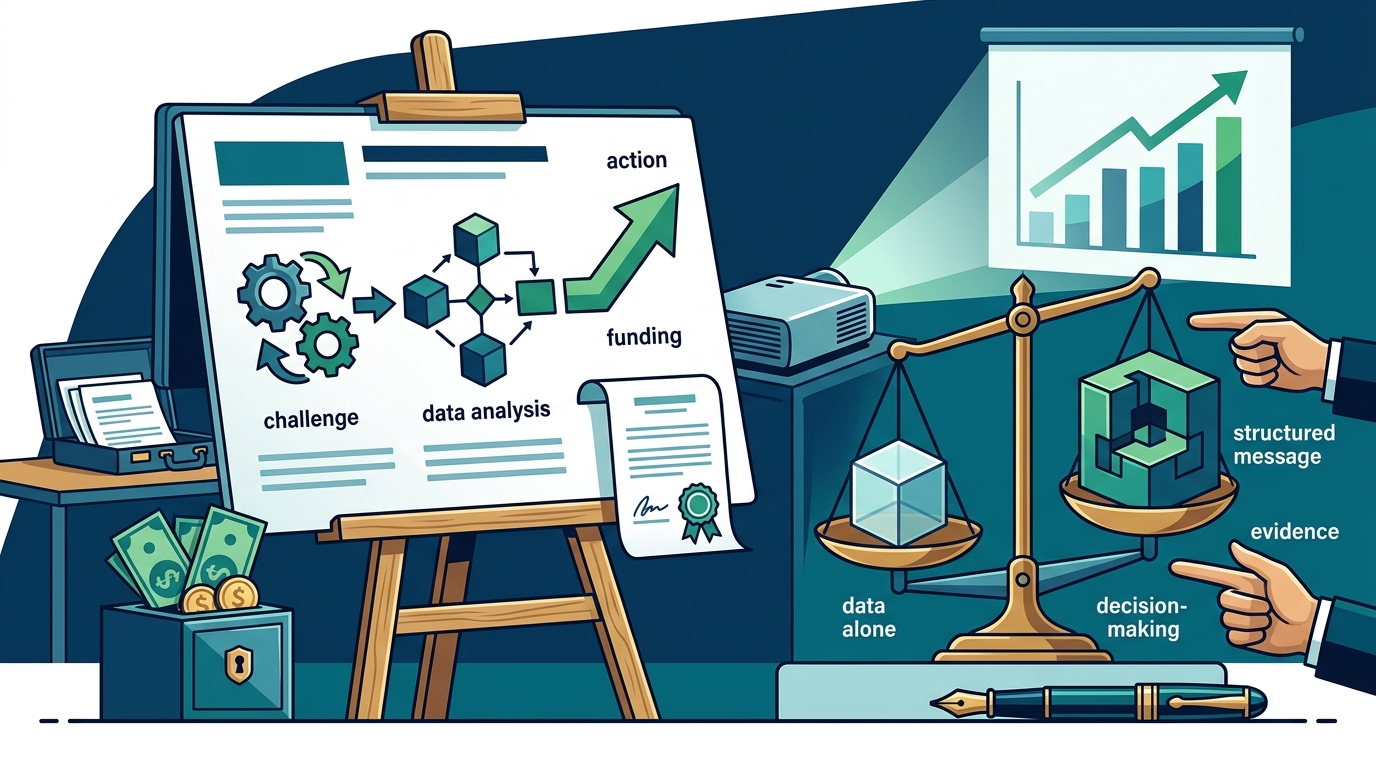
Data alone does not persuade. Data storytelling is the practice of pairing quantitative evidence with narrative context so stakeholders grasp both the facts and their implications. According to research from Insight7, stakeholders are more likely to engage when data is presented in a manner that aligns with their objectives and concerns.
Pair Statistics With Real-World Examples
A chart showing a 15% efficiency gain is useful. A chart paired with a brief story about how a pilot team achieved that gain is persuasive. Combining analytical evidence with relatable context reduces skepticism and builds emotional buy-in simultaneously.
4. Executive Presence and Delivery
Executive presence is not about personality or style. It is about how you are perceived when you speak. Stakeholders judge your credibility within seconds of your opening, and that initial impression shapes how your entire message is processed. Confident eye contact, controlled pacing, purposeful gestures, and the elimination of filler words all signal authority.
Professionals who invest in executive coaching build the delivery habits that earn trust under pressure. Vocal variety, intentional pauses, and composure during difficult questions are all trainable skills, not innate gifts.
5. Visual Design That Supports Your Message
Slides should support your voice, not compete with it. Most professionals were never taught how to build an effective business slide deck, and the result is presentations that are overloaded, hard to follow, and too dependent on the screen. When a deck looks busy, the audience loses confidence fast.
Cleaner visuals, clearer structure, and more intentional slide choices increase authority and make your message easier to absorb. Focus each slide on a single idea, use data visualizations instead of text-heavy bullet points, and design for the back row. For hands-on guidance, the Winning Slide Decks Masterclass teaches business professionals how to build decks that work harder in every meeting.
6. Handling Objections and Q&A
A persuasive presentation does not end when you finish your last slide. Stakeholder Q&A is often where decisions are actually made. Anticipate the two or three most likely objections and prepare concise, evidence-backed responses. Stay composed, acknowledge the concern, and redirect to your core recommendation.
Practicing objection handling in a low-stakes environment builds the muscle memory you need when the pressure is real. Programs like public speaking training at Effective Presentations include live Q&A practice with direct coaching so participants can refine this skill before it counts.
7. Closing With a Clear Call to Action
The most dangerous response to your presentation is not rejection. It is enthusiastic agreement that generates zero follow-through. Every stakeholder presentation should end with a specific, actionable request: approve the budget, assign the team, schedule the pilot. Vague closings produce vague outcomes.
Summarize the discussion by tying everything back to stakeholder goals and clearly defining next steps. A strong close transforms passive approval into active commitment.
Persuasive Presentation Elements at a Glance
| Element | Purpose | Common Mistake | Impact on Stakeholders |
|---|---|---|---|
| Audience Analysis | Tailor content to decision-maker priorities | Presenting the same deck to every audience | Higher relevance and engagement |
| Message Structure | Make ideas easy to follow and defend | Burying the recommendation at the end | Faster comprehension and alignment |
| Data Storytelling | Build credibility with evidence and narrative | Presenting raw data without context | Stronger buy-in and reduced skepticism |
| Executive Presence | Project confidence and authority | Relying on slides instead of delivery | Increased trust and perceived competence |
| Visual Design | Reinforce key points visually | Overloading slides with text | Better retention and clarity |
| Objection Handling | Address concerns and build consensus | Getting defensive or dismissive | Demonstrates preparation and credibility |
| Call to Action | Drive a specific decision or next step | Ending with "any questions?" | Converts agreement into commitment |
Key Takeaways
- Start every presentation by mapping your stakeholders' priorities, concerns, and decision criteria.
- Structure your message so the recommendation is clear within the first two minutes.
- Pair data with real-world stories to make evidence both credible and relatable.
- Executive presence is a learnable skill that directly affects how your ideas are received.
- Design slides to support your voice, not replace it. One idea per slide is a reliable rule.
- Prepare for Q&A as deliberately as you prepare your opening. Decisions often happen here.
- Always close with a specific, actionable request tied to stakeholder goals.
Frequently Asked Questions
What is a persuasive business presentation?
A persuasive business presentation is a structured communication designed to influence stakeholders' beliefs, attitudes, or decisions in favor of a proposed course of action. It combines clear messaging, credible evidence, and confident delivery to move an audience toward a specific outcome.
How do I tailor a presentation to different stakeholders?
Use stakeholder mapping to document each person's concerns, influence level, and degree of support. Then customize your key points, evidence, and language to address what each group values most. A presentation for a CFO will emphasize ROI; a presentation for an operations leader will emphasize implementation feasibility.
Why is message structure so important for persuasion?
Because audiences make rapid decisions about which information deserves their attention. A clear structure, with the recommendation up front and supporting evidence organized logically, reduces cognitive load and makes it easier for stakeholders to say yes.
How does storytelling make a business presentation more persuasive?
The brain remembers stories far better than data alone. Pairing statistics with narrative context creates both intellectual and emotional engagement, which increases retention and makes stakeholders more likely to act on your recommendation.
What role does executive presence play in persuading stakeholders?
Executive presence shapes how your audience perceives your authority and credibility. Strong delivery, including eye contact, vocal control, and composed body language, signals that you are confident in your recommendation, which increases the likelihood stakeholders will trust and follow it.
How should I handle tough questions during a stakeholder presentation?
Anticipate objections in advance and prepare concise, evidence-backed responses. During Q&A, acknowledge the concern, respond directly, and redirect back to your core recommendation. Staying composed under pressure builds credibility rather than undermining it.
What is the biggest mistake people make in stakeholder presentations?
Ending without a clear call to action. Many presenters deliver strong content but close with a vague "let me know what you think." A specific request, such as "approve this budget by Friday" or "assign a project lead this week," converts interest into action.
Can presentation skills for stakeholder influence be trained?
Yes. Effective Presentations has trained over 100,000 professionals with hands-on coaching that covers message structure, delivery, executive presence, and Q&A handling. These skills improve measurably with structured practice and expert feedback.
Build the Skills That Move Stakeholders to Action
Knowing the elements of a persuasive presentation is a strong start. Practicing them with expert feedback is what makes the difference. Effective Presentations offers in-person workshops, live virtual training, and one-on-one coaching designed to help professionals communicate with clarity, confidence, and credibility in the moments that matter most. Explore business presentation skills training and take the next step toward presentations that drive decisions.