

Clear messaging is the backbone of every high-performing team. Yet most organizations struggle with it. According to research cited by Forbes, 86% of employees and executives cite poor communication as a primary cause of workplace failures. The good news? Messaging is a skill that can be learned, practiced, and sharpened over time. In this guide, you will learn a proven process for refining your team's messaging so that every conversation, presentation, and meeting drives alignment and results. Whether your team works in person, remotely, or in a hybrid model, these strategies will help you communicate with clarity, confidence, and credibility.
Why Team Messaging Matters More Than Ever
Team messaging is the process of crafting, delivering, and refining how group members share information, ideas, and feedback to achieve shared goals. It goes far beyond choosing a chat app. It includes the words you select, the structure you use, and the clarity of your intent.
The data paints a stark picture. Grammarly's 2025 report found that effective communication can save workers up to 25.2 hours per week. On the flip side, poor communication costs companies between $3,640 and $37,440 per employee per year. When messaging is unclear, teams waste time, miss deadlines, and lose trust.
Organizations that invest in effective communication skills training see measurable gains. McKinsey data shows that companies with strong communication practices are 3.5 times more likely to outperform their peers.
Common Messaging Breakdowns Teams Face
Before you can fix your messaging, you need to recognize where it breaks down. A messaging breakdown is a failure in how information is structured, delivered, or received that leads to confusion or inaction.
Information Overload
Microsoft's 2025 Work Trend Index found that the average knowledge worker receives 153 Teams messages per weekday and is interrupted every two minutes during core work hours. When every message feels urgent, none of them are.
Scattered Communication Channels
Teams today split attention across Slack, email, Microsoft Teams, SMS, and more. ClickUp research shows that over 60% of a team's time is spent searching for context, information, and action items across disconnected platforms.
Vague or Unstructured Messages
When speakers fail to organize their thoughts, audiences disengage. As trainers at Effective Presentations emphasize, the moment you deliver a standard, all-purpose message, you will lose even your most engaged audience.
A Proven Framework for Refining Your Message
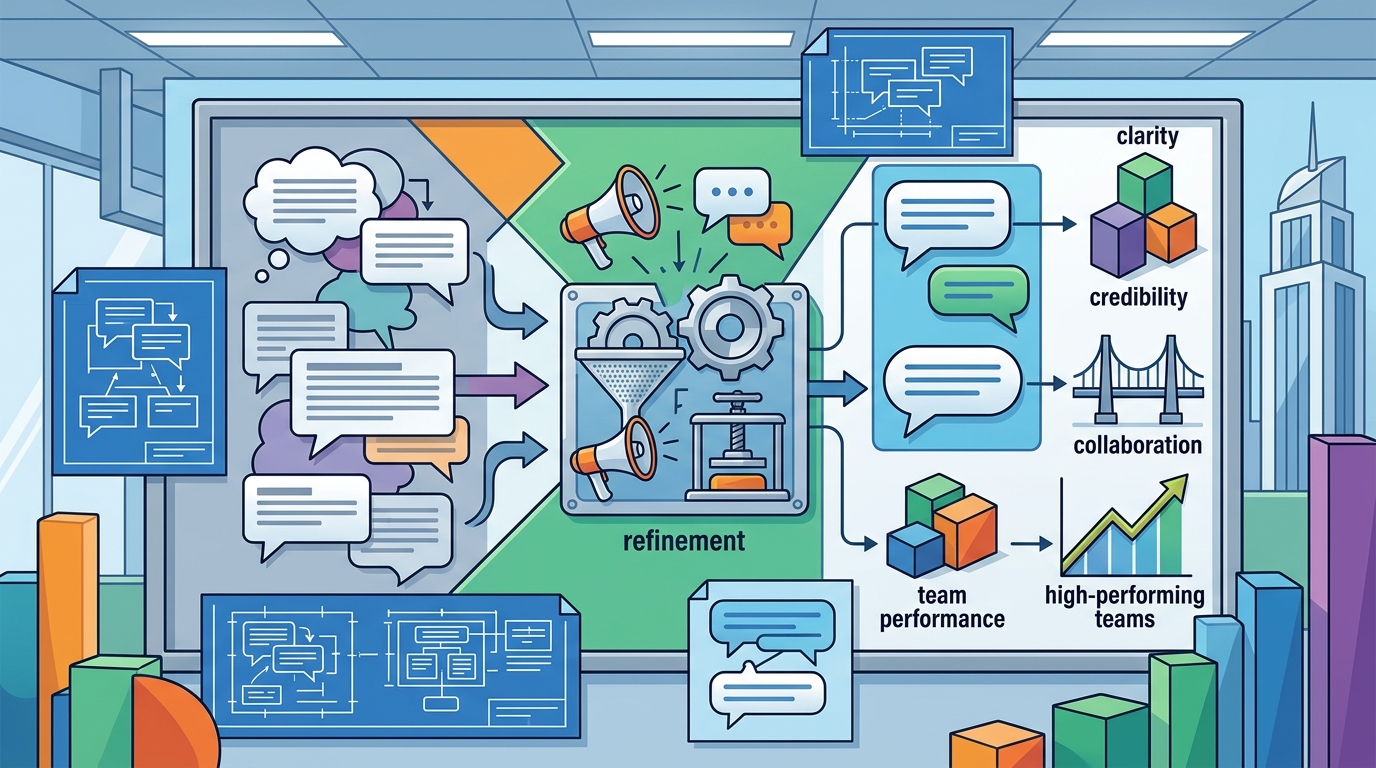
Message refinement is the deliberate process of structuring, simplifying, and tailoring your communication so your key points land with maximum impact. Here is a step-by-step approach your team can follow.
Step 1: Define Your Core Message
Before opening any slide deck or writing any email, ask: What is the one thing my audience must walk away knowing? Start with the conclusion, then build supporting evidence around it. This approach, taught in messaging structure masterclasses, prevents "data dumping" and keeps your audience focused.
Step 2: Know Your Audience
Different team members process information differently. Some are data-focused, others are visionaries, and some are empaths. Tailor your language and format to match your audience. A technical update for engineers requires a different structure than a strategic briefing for executives.
Step 3: Use a Clear Structure
Organize every message with a beginning, middle, and end. Use frameworks like Problem-Solution-Benefit or Situation-Complication-Resolution to guide your thinking. This ensures consistency whether you are presenting in a boardroom or posting in a team channel.
| Element | Before Refinement | After Refinement |
|---|---|---|
| Opening | "I wanted to update you on a few things..." | "We need to decide on vendor X by Friday. Here is why." |
| Structure | Stream-of-consciousness paragraphs | Problem → Evidence → Recommendation |
| Call to Action | None or implied | "Please review and reply by Thursday at 3 PM." |
| Length | 500+ words with tangents | Under 200 words, focused |
| Audience Fit | One version for everyone | Tailored to the decision-maker's priorities |
Build a Culture of Active Listening
Refined messaging is not just about the sender. Active listening is the practice of giving complete attention to a speaker, asking clarifying questions, and reflecting back what was heard. Without it, even the best-structured message can be misinterpreted.
Encourage team members to paraphrase key points after meetings. Schedule regular check-ins where people practice summarizing what they heard before responding. Training programs like leadership communication training build these habits through coached practice and real-time feedback.
Choose the Right Tools and Channels
Not every message belongs in every channel. Matching your communication method to the situation reduces noise and improves clarity.
- Email: Best for formal updates, documentation, and detailed instructions that need a paper trail.
- Instant messaging (Slack, Teams): Ideal for quick questions, status updates, and informal coordination.
- Video calls: Use for complex discussions, brainstorming, and situations requiring emotional nuance.
- Presentations: Reserve for high-stakes communication where structure, storytelling, and persuasion matter most.
For teams navigating hybrid and remote environments, virtual presentation training can bridge the gap between in-person clarity and digital delivery.
Practice, Feedback, and Repetition
Messaging improves only through deliberate practice. Reading about communication theory is not enough. Teams need to apply skills in real time, receive direct feedback, and refine through repetition.
Effective Presentations has trained over 100,000 professionals using this principle. Their corporate team training programs are customized to each organization's goals and include in-person workshops, live virtual sessions, and one-on-one coaching. The approach is experiential, not lecture-based, because the skill to do comes from doing.
Consider scheduling quarterly messaging workshops where teams practice delivering updates, pitching ideas, and handling tough questions. Video recording these sessions helps individuals spot habits they would otherwise miss.
Key Takeaways
- Poor communication costs companies thousands per employee annually and erodes team trust.
- Define your core message before choosing your medium or building your slides.
- Tailor every message to the audience's communication style and priorities.
- Use clear structures like Problem-Solution-Benefit to keep messaging focused.
- Build active listening habits through paraphrasing, check-ins, and coached practice.
- Match each communication channel to the right type of message to reduce noise.
- Invest in hands-on training and repetition to make refined messaging a lasting team habit.
Frequently Asked Questions
What is team messaging?
Team messaging is the practice of sharing information, ideas, feedback, and updates among group members to achieve shared goals. It includes verbal, written, visual, and nonverbal communication across all channels your team uses.
Why does messaging break down in teams?
Messaging breaks down due to information overload, vague language, mismatched channels, and a lack of structure. When teams do not have a shared framework for how to communicate, confusion and misalignment grow quickly.
How can we measure messaging effectiveness?
Track metrics like meeting follow-up completion rates, project timeline adherence, and employee engagement scores. Qualitative feedback through surveys and retrospectives also reveals where communication gaps exist.
What role does active listening play in team communication?
Active listening ensures that messages are received and understood as intended. It involves paying full attention, asking clarifying questions, and reflecting back key points before responding.
How often should teams practice messaging skills?
Quarterly workshops or monthly practice sessions are a strong starting point. Ongoing reinforcement through coaching, peer feedback, and real-world application accelerates improvement.
Can virtual teams refine messaging as effectively as in-person teams?
Yes. With the right training format and tools, virtual teams can achieve the same gains. Live virtual workshops with real-time coaching replicate the hands-on experience of in-person sessions.
What is the fastest way to improve team messaging?
Start with a structured workshop that combines instruction with coached practice. Programs like the Messaging Skills Workshop help teams see visible improvement in a single day by applying techniques to their own real presentations.
Take the Next Step
Your team's ability to communicate clearly is not optional. It either builds trust or breaks it. If you are ready to transform how your team delivers messages, request a customized training proposal from Effective Presentations today. With 20+ years of experience and over 1,200 five-star reviews, their hands-on approach delivers fast, measurable results for teams nationwide.