

Speaking at a conference or industry event is one of the highest-leverage opportunities a professional can have. In a single session you can build credibility, attract collaborators, and position yourself as a thought leader. Yet too many presenters squander the moment with cluttered slides, weak openings, and poor time management. Whether you are presenting at your first regional meetup or a major international summit, the practices below will help you craft a talk that resonates long after the session ends. This guide draws on proven presentation skills training principles and real-world conference advice.
1. Know Your Audience Before You Build a Single Slide
Audience analysis is the process of researching attendees' roles, expertise levels, and expectations before designing your talk. Skipping this step is one of the fastest ways to lose a room. According to presentation experts at ICC Belfast, starting with the mindset of the audience and asking "what would I want to hear?" is the foundation of a strong opening.
Research the Event Program
Review the conference agenda, keynote topics, and speaker bios. Many events publish attendee demographics or use mobile apps that reveal who will be in the room. This lets you calibrate how much background context your talk needs.
Tailor Your Depth
A good rule of thumb for a 15-minute slot is to be discussing your core data or case study by the six-minute mark. Spending too long on basics signals that you have not done your homework on the audience.
2. Structure Your Message for Maximum Clarity
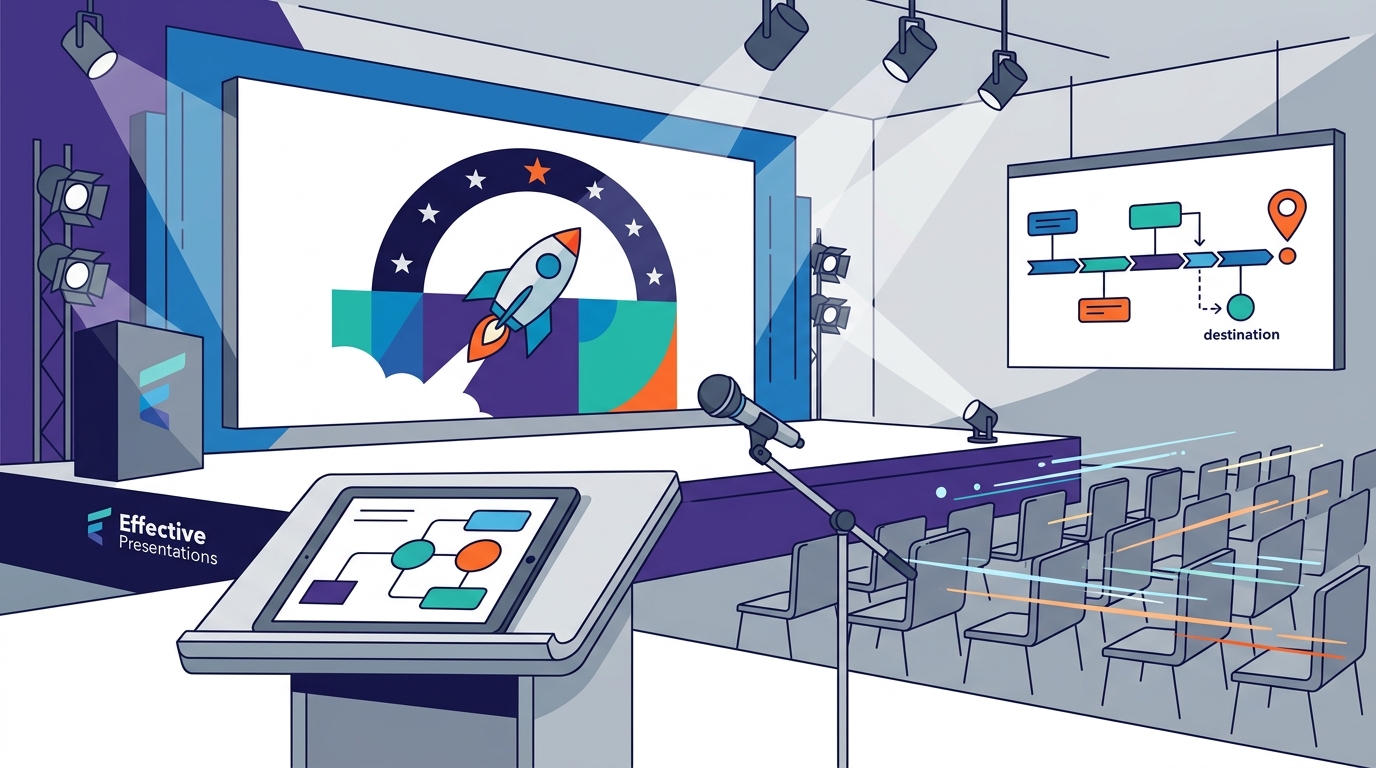
A conference presentation is a structured communication where a speaker delivers insights or findings to an audience at a formal gathering. The most effective structure follows three parts: introduction, main body, and conclusion. Effective Presentations' messaging and structure workshop teaches professionals to organize content around one core takeaway so the audience leaves with a clear, actionable message.
Open With a Hook
Begin with a thought-provoking question, a surprising statistic, or a short story that connects emotionally. Then state your purpose clearly so listeners know exactly what they will gain. Learn more techniques in our guide on how to open a presentation.
Close With a Call to Action
Summarize your main takeaways and reinforce the message with a memorable closing statement. Our post on how to close a presentation covers proven techniques for ending strong.
3. Design Clean, High-Impact Slides
Visual clutter kills comprehension. Slides should use minimal text, clear fonts, and high-contrast colors. A practical guideline is one slide per minute, maximum. The goal is for the oral delivery to add value to the slide, not simply repeat it. If you need help building better decks, explore our Winning Slide Decks masterclass.
Use visuals like charts, diagrams, and images to support your narrative rather than walls of bullet points. Research from the International Federation for Emergency Medicine confirms that slides should be self-contained, with the speaker adding context the audience cannot get from reading alone.
4. Master Your Delivery and Stage Presence
Executive presence is the combination of confidence, poise, and vocal authority that makes a speaker command attention. Even with perfect slides, poor delivery undermines credibility. Practice out loud, not just in your head. Nerves typically cause speakers to speed up, so rehearsing at a deliberate pace is essential.
Engage the audience through eye contact, purposeful gestures, and interactive elements like quick polls or directed questions. Organizations like TED and Salesforce's Dreamforce invest heavily in speaker coaching because delivery quality directly impacts audience retention. Our executive presence techniques article covers the five methods top leaders use on stage.
5. Manage Your Time Like a Professional
Going over time is widely considered the cardinal sin of conference presenting. If your slot is 15 minutes, prepare 15 minutes of material. Use rehearsal timing tools in PowerPoint or Keynote to verify your pace. Overrunning your slot cuts into Q&A time, which is often the most valuable part of the session for both you and the audience.
6. Handle the Q&A With Confidence
Anticipate likely questions and prepare concise answers. Keep a notebook handy to jot down insightful questions you want to reflect on later. If you face a tough or hostile question, stay calm, acknowledge the questioner, and redirect to your evidence. For deeper strategies, read our guide to handling audience questions.
Conference Presentation Comparison Table
| Element | Common Mistake | Best Practice |
|---|---|---|
| Opening | Starting with "My name is..." | Lead with a hook, then introduce yourself |
| Slides | 40+ text-heavy slides for 15 min | One slide per minute, mostly visual |
| Timing | Running 5+ minutes over | Rehearse with a timer; trim if needed |
| Audience Engagement | Reading slides word-for-word | Eye contact, questions, and storytelling |
| Q&A Preparation | Winging it | Pre-draft answers to 5 likely questions |
| Closing | Ending with "That's it" | Summarize takeaways and give a clear CTA |
Key Takeaways
- Research your audience and the event program before designing any slides.
- Structure every talk around one core message using an introduction-body-conclusion framework.
- Keep slides visual and minimal; aim for one slide per minute at most.
- Rehearse out loud with a timer to prevent overrunning your slot.
- Open with a hook and close with a memorable call to action.
- Prepare for the Q&A by anticipating at least five likely questions in advance.
- Invest in professional presentation skills training to accelerate your growth.
Frequently Asked Questions
How long should a conference presentation be?
Most conference sessions range from 15 to 20 minutes for the talk, plus 5 to 10 minutes for questions. Always confirm the exact time allotted with the organizer and rehearse to fit within that window.
How many slides should I use for a 15-minute presentation?
A practical estimate is one slide per minute, so roughly 12 to 15 slides. Focus on visual clarity rather than quantity.
What is the best way to start a conference presentation?
Open with a thought-provoking question, a surprising fact, or a short narrative that connects to your core message. Then clearly state your purpose and outline what the audience will gain.
How do I manage nervousness before presenting at a conference?
Practice out loud multiple times, use deep breathing techniques, and arrive early to familiarize yourself with the stage setup. Our resource on overcoming speech anxiety offers a detailed system.
Should I memorize my conference presentation?
Memorizing word-for-word often leads to a robotic delivery. Instead, know your key points cold and practice transitioning between them naturally.
How do I handle difficult questions during Q&A?
Stay composed, restate the question for the audience, and respond with evidence. If you do not know the answer, say so honestly and offer to follow up after the session.
What makes a conference presentation memorable?
Storytelling, clean visuals, confident delivery, and a clear call to action are the four pillars of a memorable talk. Combining all four separates good presentations from great ones.
Take Your Conference Presentations to the Next Level
Reading tips is a solid start, but lasting improvement comes from hands-on practice with expert feedback. Effective Presentations offers presentation skills training designed for professionals who need to deliver high-stakes talks at conferences, board meetings, and industry events. Request a proposal today and turn your next conference appearance into a career-defining moment.