

How Teams Refine Their Messaging for Improved Communication and Collaboration
Every team communicates, but few communicate well. Research shows that 45% of employees say poor communication erodes trust among coworkers, while knowledge workers spend roughly 60% of their day trapped in email, chat, and meetings. The gap between talking and truly connecting costs organizations billions in lost productivity each year. Message refinement is the deliberate process of sharpening what your team says, how it is structured, and how it lands with the people who need to act on it. In this guide, you will learn practical steps teams use to transform scattered ideas into clear, compelling messages that drive real collaboration.
Why Messaging Quality Matters More Than Volume
Teams are drowning in messages, not meaning. According to Microsoft's 2025 Work Trend Index, the average knowledge worker receives 153 Teams messages per weekday and is interrupted roughly every two minutes. More communication does not equal better communication.
The real cost is trust. A Forbes survey found that 45% of employees said poor communication directly affects their ability to trust coworkers. Meanwhile, 40% of employees report burnout, stress, and fatigue tied to communication issues. Message refinement is how teams break this cycle by replacing noise with clarity.
Audit Your Team's Current Messaging Habits
Before you fix messaging, you need to see it clearly. A messaging audit is a structured review of how your team currently communicates across meetings, emails, presentations, and chat. Start by asking three questions:
- Are our messages organized around what the audience needs to know, or around what we want to say?
- Do people leave our meetings and presentations knowing exactly what to do next?
- How often do we repeat or clarify information that should have been clear the first time?
Many teams discover they are what Effective Presentations calls "data dumpers," people who share information without shaping it into a story the audience can follow and remember. The Messaging and Structure Workshop specifically helps professionals move from dumping data to crafting messages that inform, inspire, and persuade.
Common Messaging Problems to Look For
| Symptom | Root Cause | Impact on Collaboration |
|---|---|---|
| Meetings run long with no clear outcome | No message structure or stated purpose | Wasted time, follow-up confusion |
| Emails require multiple clarifications | Unfocused writing, buried action items | Delayed decisions, frustration |
| Presentations fail to persuade | Speaker-centered instead of audience-centered | Lost buy-in, stalled projects |
| Repetitive Slack/Teams threads | Information scattered across channels | Cognitive overload, duplicated effort |
| Inconsistent updates across departments | No shared vocabulary or framework | Misalignment, trust erosion |
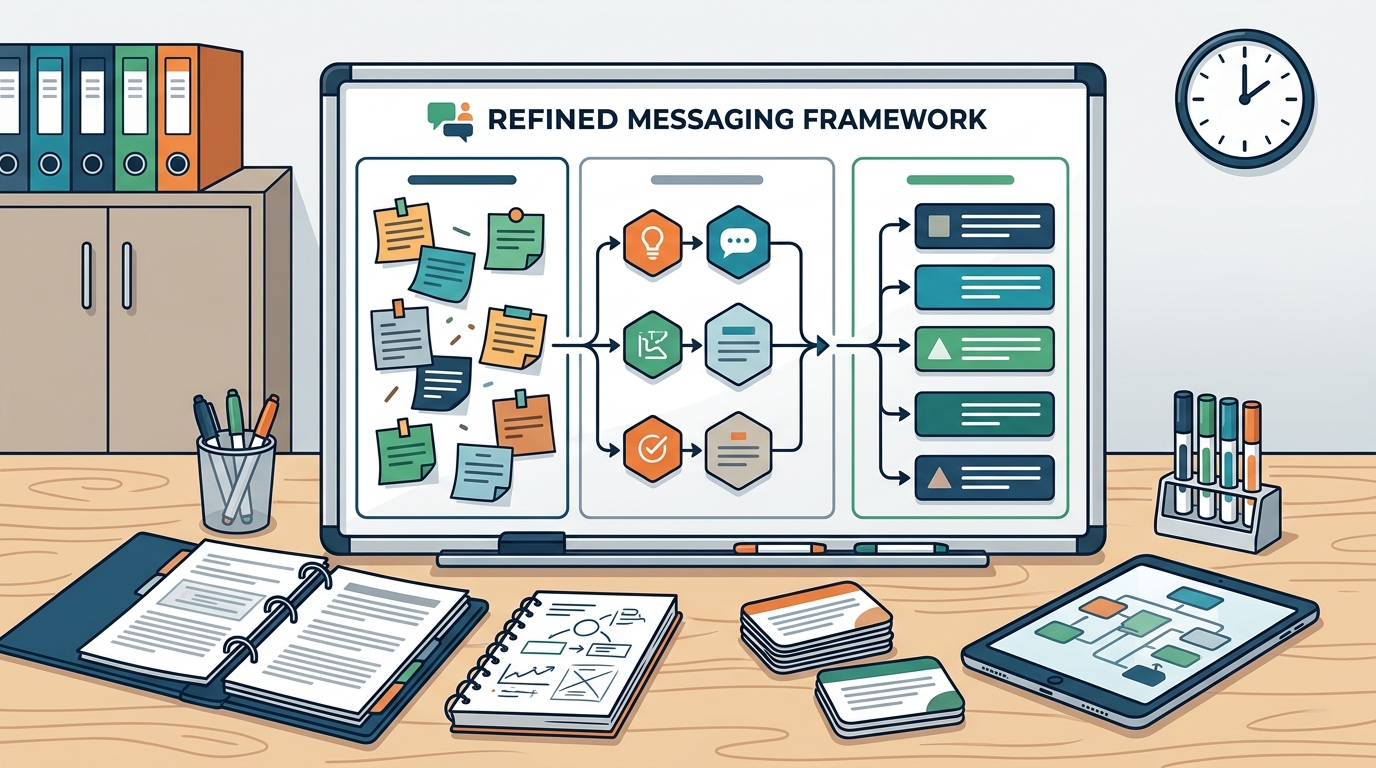
Build a Shared Messaging Framework
A messaging framework is a reusable structure that helps every team member organize their thoughts before they speak or write. It answers: What is the point? Why does it matter to this audience? What do you need them to do?
Start With Audience, Not Content
The most common mistake teams make is building messages around their own expertise rather than the listener's needs. Strong communicators flip this. They open with a clear purpose so the audience immediately knows what is being asked of them. This single shift can cut meeting time and dramatically reduce follow-up messages.
Use a Repeatable Structure
Frameworks like "situation, recommendation, evidence, next step" give teams a shared language for organizing any update, pitch, or briefing. When the whole team uses the same structure, collaboration becomes faster because people know where to find the key information in any message. Effective Presentations' presentation skills training teaches these frameworks through coached practice so they become habits, not theories.
Use Practice and Feedback Loops
Knowing a framework is not the same as using it under pressure. Coached practice is the bridge between understanding a concept and performing it consistently. This is why hands-on training programs outperform passive learning formats like webinars and slide decks.
At Effective Presentations, participants present multiple times per session, receive direct coaching after each attempt, and apply adjustments immediately. Corporate team training customizes these practice scenarios to the real presentations, meetings, and pitches your people deliver every week. The result is visible improvement within a single day.
Peer Feedback Accelerates Growth
Team-based practice sessions create a feedback culture that extends beyond the training room. When colleagues learn to give specific, constructive input on each other's messaging, the quality of everyday communication rises. According to The Predictive Index, professional communications training is a proven method for strengthening lines of communication between staff.
Choose the Right Tools and Channels
Tools do not fix bad messaging, but the wrong tools make good messaging harder. Research from Zoom shows that employees using more than 10 apps report communication issues at a 54% rate, compared to 34% for those using fewer than five. Channel discipline is the practice of matching the message type to the right medium.
Quick status updates belong in chat. Complex decisions deserve a live conversation. Persuasive recommendations call for a well-structured presentation. When teams agree on which channel serves which purpose, they reduce noise and protect focus time. For teams that present frequently, live virtual training builds the delivery skills needed to make every video call and presentation count.
Measure Messaging Improvement Over Time
What gets measured gets refined. Track these indicators to see if your messaging efforts are working:
- Meeting efficiency: Are meetings ending on time with clear next steps?
- Follow-up volume: Are clarification emails and messages decreasing?
- Presentation outcomes: Are proposals getting approved faster?
- Team confidence: Do people feel more comfortable speaking up?
- Stakeholder feedback: Are clients and executives responding more positively?
Organizations that invest in structured communication training see measurable gains. The Institute for Corporate Productivity found a 39% increase in productivity in companies that strengthen team collaboration. Pairing training with ongoing public speaking coaching ensures skills continue to sharpen after the initial workshop.
Key Takeaways
- Message refinement is about quality and structure, not sending more messages.
- A messaging audit reveals whether your team communicates for the audience or at the audience.
- Shared frameworks give teams a common language that speeds up collaboration.
- Coached practice with real-time feedback builds skills faster than passive learning.
- Channel discipline reduces cognitive overload and protects deep work time.
- Measuring outcomes like follow-up volume and meeting efficiency proves ROI.
- Ongoing training and peer feedback sustain improvement long after an initial workshop.
Frequently Asked Questions
What is message refinement in a team setting?
Message refinement is the process of improving the clarity, structure, and audience focus of a team's verbal and written communication. It involves auditing current habits, adopting shared frameworks, and practicing delivery until clear messaging becomes the default.
Why do teams struggle with messaging even when they communicate frequently?
Volume does not equal clarity. Many teams over-communicate without structuring their messages around what the audience needs to know and do. This leads to information overload, repeated clarifications, and wasted meeting time.
How can a messaging framework improve collaboration?
A messaging framework is a repeatable structure that organizes any message around purpose, audience need, evidence, and next steps. When everyone on the team uses the same approach, information is easier to find, meetings run faster, and decisions happen with less back-and-forth.
What role does practice play in refining team messaging?
Practice is what turns knowledge into skill. Coached practice, where team members present, receive direct feedback, and immediately apply adjustments, produces faster improvement than reading about techniques or watching presentations.
How long does it take for a team to improve its messaging?
Many participants in hands-on workshops notice stronger confidence and clarity within the first day. Sustained improvement comes from ongoing practice, peer feedback, and follow-up coaching sessions.
What tools help teams communicate more effectively?
The best tool stack is a small, connected set of platforms where each channel has a clear purpose. Chat for quick updates, video calls for complex discussions, and structured presentations for persuasive recommendations. Fewer apps with clear norms outperform a bloated tech stack.
How do you measure whether team messaging has improved?
Track meeting length and clarity of outcomes, volume of follow-up clarification messages, proposal approval rates, and qualitative feedback from stakeholders. Declining follow-up volume is one of the clearest early indicators of better messaging.
Can remote and hybrid teams refine messaging as effectively as in-person teams?
Yes. Live virtual training formats deliver the same coached practice and real-time feedback as in-person workshops. Effective Presentations caps virtual sessions at five or six participants to ensure each person gets meaningful practice and individual coaching.
Refine Your Team's Messaging Starting Today
Clear messaging is not a personality trait. It is a trainable skill that compounds across every meeting, presentation, and email your team sends. If your team is ready to stop over-communicating and start connecting, explore Effective Presentations' team training programs and bring hands-on, coached practice to the people who represent your organization every day.