

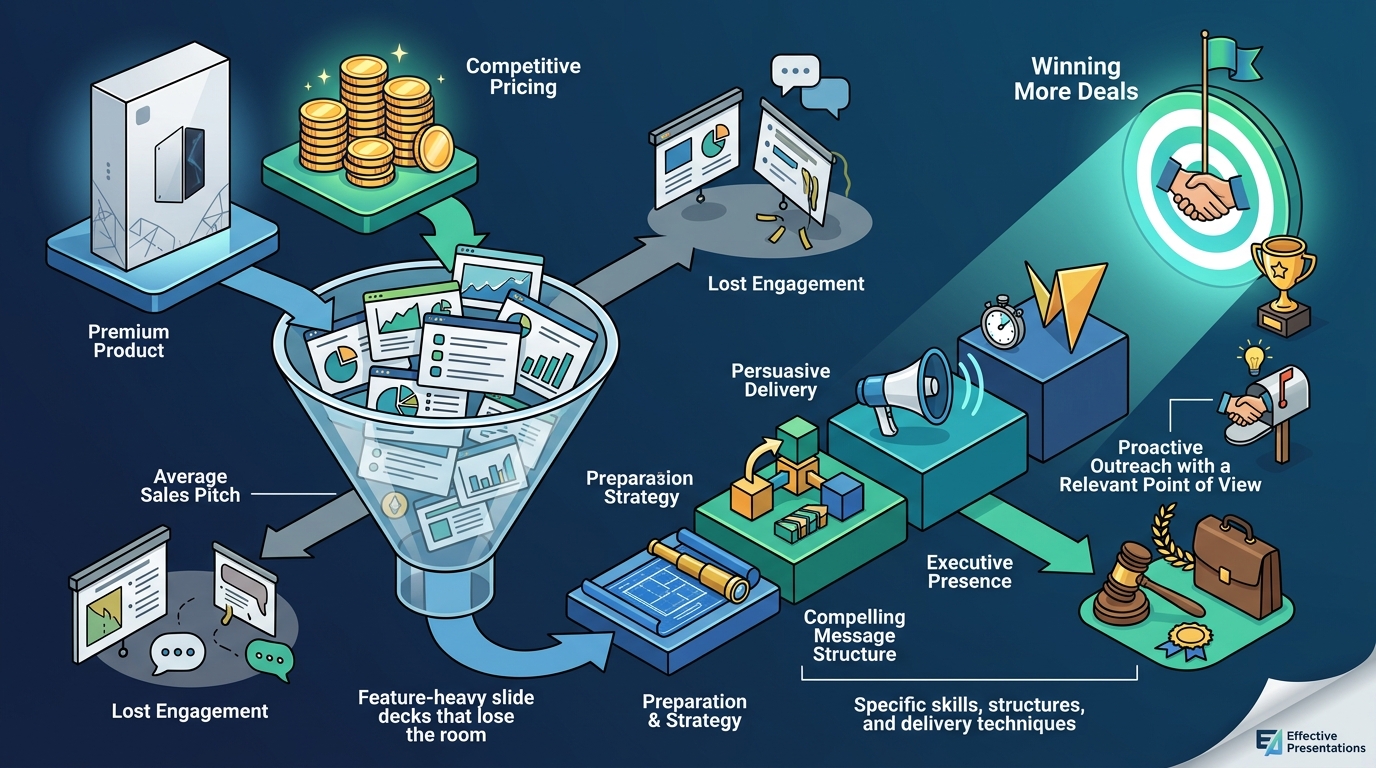
A polished product and a competitive price mean nothing if your sales presentation falls flat. Research from RAIN Group shows that 82% of buyers say they accept meetings with sellers who proactively reach out with a relevant point of view. Yet most sales professionals still default to feature-heavy slide decks that lose the room in minutes. This guide walks you through the specific skills, structures, and delivery techniques that turn average sales pitches into deal-closing conversations. Whether you sell SaaS, professional services, or enterprise solutions, these strategies will help you present with more confidence and close with more consistency.
Why Most Sales Presentations Fail
The biggest reason sales presentations miss the mark is information overload. Presenters cram too many slides, talk too long, and lose the buyer's attention. A common mistake is using too much "I," "we," and "our" language instead of "you" and "your."
Another frequent error is skipping the opening hook. If you fail to have a strong opening and close, your audience disengages before you reach your value proposition. You can explore the most damaging habits in our breakdown of six ways you may be messing up your sales pitch.
Start with Audience Research, Not Slides
Audience research is the process of identifying your prospect's pain points, decision criteria, and business context before you design a single slide. Great sales presenters tailor their pitch to different buyers rather than delivering a generic deck.
Identify the Real Decision Makers
Map out who will be in the room, what they care about, and what objections they are likely to raise. Use LinkedIn, earnings calls, and pre-meeting discovery calls to gather insight.
Align Your Message to Buyer Needs
Frame every benefit around the prospect's specific challenges. Our messaging and structure training teaches professionals how to organize content so the audience hears what matters most to them first.
Structure Your Pitch for Maximum Impact
A sales pitch is a formal type of sales presentation, usually used in longer buying cycles where multiple touchpoints are needed before a deal closes. Structure gives your pitch clarity and momentum.
The Problem-Solution-Proof Framework
Open by naming the prospect's problem. Present your solution as the logical answer. Then prove it with data, case studies, or customer testimonials. This three-part flow keeps the buyer engaged and reduces resistance.
Close with a Clear Call to Action
Never end a sales presentation without telling the audience exactly what happens next. Whether it is scheduling a pilot, signing a contract, or booking a follow-up call, make the ask explicit. Our guide on how to close a presentation effectively covers this in detail.
Use Storytelling to Make Your Message Stick
According to research published by Harvard Business Review, stories trigger the release of oxytocin in the brain, increasing trust and willingness to cooperate. In sales, that translates directly to buying behavior.
Replace generic feature lists with short customer success stories. Describe the situation, the challenge, the action you took, and the result. Buyers remember narratives far longer than bullet points. Learn techniques for weaving stories into business contexts through our resource on storytelling in business.
Master Delivery Skills That Build Trust
Your delivery is the vehicle that carries your message. Even a perfectly structured pitch can fall apart if your body language, vocal variety, or eye contact sends the wrong signals.
Body Language and Eye Contact
Maintaining steady eye contact builds credibility. Open gestures and purposeful movement project confidence. Explore how nonverbal cues shape perception in our article on body language in negotiations.
Vocal Variety and Pacing
Vocal variety is the deliberate modulation of pitch, pace, volume, and pauses to keep an audience engaged. Monotone delivery signals disinterest. Varying your speed and emphasis draws attention to your most important points.
Confidence Without Arrogance
Confidence comes from preparation, not personality. Practice your pitch until you could deliver it without slides. Our guide to speaking confidently offers practical exercises that build genuine self-assurance.
Handle Objections and Questions with Confidence
Objections are not roadblocks. They are buying signals. When a prospect pushes back, it means they are engaged enough to care. Skilled presenters welcome objections because they reveal exactly what the buyer needs to hear before saying yes.
Use active listening techniques: repeat the objection back, validate the concern, and respond with evidence. The 80/20 rule applies here. Listen 80% of the time and speak 20%. Read more about how active listening strengthens communication.
Sales Presentation Approaches Compared
| Approach | Best For | Key Strength | Common Pitfall |
|---|---|---|---|
| Feature-Led Pitch | Technical buyers | Detail and specificity | Information overload |
| Story-Led Pitch | Executive sponsors | Emotional connection | Lacking data support |
| Consultative Pitch | Complex, long-cycle sales | Builds trust through dialogue | Requires deep discovery |
| Demo-Led Pitch | Product-driven sales | Shows value in real time | Tech failures, pacing issues |
| ROI-Focused Pitch | CFOs, finance stakeholders | Quantifiable business case | Feels impersonal if overused |
Key Takeaways
- Always research your audience before building your slides or script.
- Structure every pitch around a clear problem, solution, and proof.
- Replace feature lists with customer success stories for stronger retention.
- Use body language, vocal variety, and eye contact to reinforce credibility.
- Treat objections as buying signals and respond with evidence, not defensiveness.
- Close every presentation with a specific, actionable next step.
- Invest in hands-on sales presentation training for lasting improvement.
Frequently Asked Questions
What are the most important sales presentation skills?
The most important skills include audience analysis, clear message structure, storytelling, confident delivery, active listening, and the ability to handle objections. Together, these skills help you connect with buyers and move deals forward.
How long should a sales presentation be?
Most effective sales presentations last between 15 and 25 minutes, leaving time for questions and discussion. Shorter is almost always better. Buyers rarely complain that a pitch was too brief.
How do I overcome nervousness before a sales pitch?
Preparation is the most reliable cure. Rehearse your presentation multiple times, practice with a colleague, and use controlled breathing before you present. Structured training programs accelerate this process significantly.
Should I use PowerPoint in a sales presentation?
Slides can support your message, but they should never be the message. Use visual aids that are truly visual: images, charts, and short phrases. Avoid text-heavy slides that tempt you to read aloud.
What is the best way to open a sales presentation?
Start with a relevant insight, a surprising statistic, or a question that speaks directly to your prospect's challenge. Avoid opening with your company history or a generic agenda slide.
How can I make my sales pitch more interactive?
Ask questions throughout, invite the prospect to share their priorities, and use trial closes to check for agreement at key moments. Interactive presentations keep the buyer engaged and give you real-time feedback on how your message is landing.
What is the difference between a sales pitch and an elevator pitch?
A sales pitch is a formal, structured presentation typically used in longer buying cycles. An elevator pitch is a concise, 30- to 60-second summary of what you do and why it matters, designed for casual or spontaneous encounters.
How do I improve my sales presentation skills quickly?
The fastest path is hands-on practice with expert feedback. Professional business presentation skills training combines live coaching, video review, and structured exercises to accelerate improvement in days rather than months.
Ready to Sharpen Your Sales Presentation Skills?
Strong sales presentations do not happen by accident. They are built through practice, feedback, and the right frameworks. At Effective Presentations, we help sales professionals and teams develop the communication skills that win trust, shorten sales cycles, and close more deals. Request a proposal today to bring our proven training to your team.