

How Teams Refine Their Messaging for Improved Communication and Collaboration
Clear messaging is the difference between a team that moves fast and one that spins its wheels. When everyone on a team uses the same structure, vocabulary, and intent behind their messages, collaboration accelerates and misunderstandings shrink. Yet most teams never formally train this skill. They assume good communicators are born, not built. The truth is that messaging is a repeatable, coachable competency, and the teams that treat it that way consistently outperform those that don't. This guide walks you through the proven steps teams use to sharpen their messaging and unlock stronger collaboration.
The Real Cost of Unclear Messaging
Vague, unfocused messaging does not just slow teams down. It drains budgets. According to Grammarly's 2025 State of Business Communication report, ineffective communication costs U.S. businesses up to $1.2 trillion annually. On the individual level, research from Axios HQ estimates that poor communication costs between $10,000 and $55,000 per employee per year.
The damage goes beyond dollars. A SHRM-cited survey of 400 companies with 100,000 employees each found an average loss of $62.4 million per company per year from communication breakdowns. Meanwhile, 86% of employees and executives attribute workplace failures to a lack of effective communication and collaboration.
What Message Refinement Actually Means
Message refinement is the deliberate process of clarifying, structuring, and sharpening what a team communicates so that every statement lands with purpose. It is not about choosing fancier words. It is about leading with context, stating your point early, and supporting it with the right level of detail.
A shared messaging framework is a set of reusable structures and principles that give every team member a common language for organizing their ideas. When a team adopts one, meetings get shorter, emails get clearer, and decisions happen faster. Programs like the Messaging and Structure workshop from Effective Presentations teach exactly this kind of repeatable skill.
Step 1: Audit How Your Team Communicates Today
Before you fix anything, diagnose the problem. Run a quick internal pulse survey asking one question: "Where did unclear communication cost us time this week?" Track the answers across meetings, emails, Slack threads, and presentations.
Common Symptoms of Weak Messaging
- Meetings that end without clear next steps
- Emails requiring multiple follow-ups for clarification
- Stakeholders asking, "What's the point?" after updates
- Cross-functional handoffs where requirements get lost
This baseline becomes your internal ROI argument for investing in corporate communication training.
Step 2: Adopt a Shared Messaging Framework
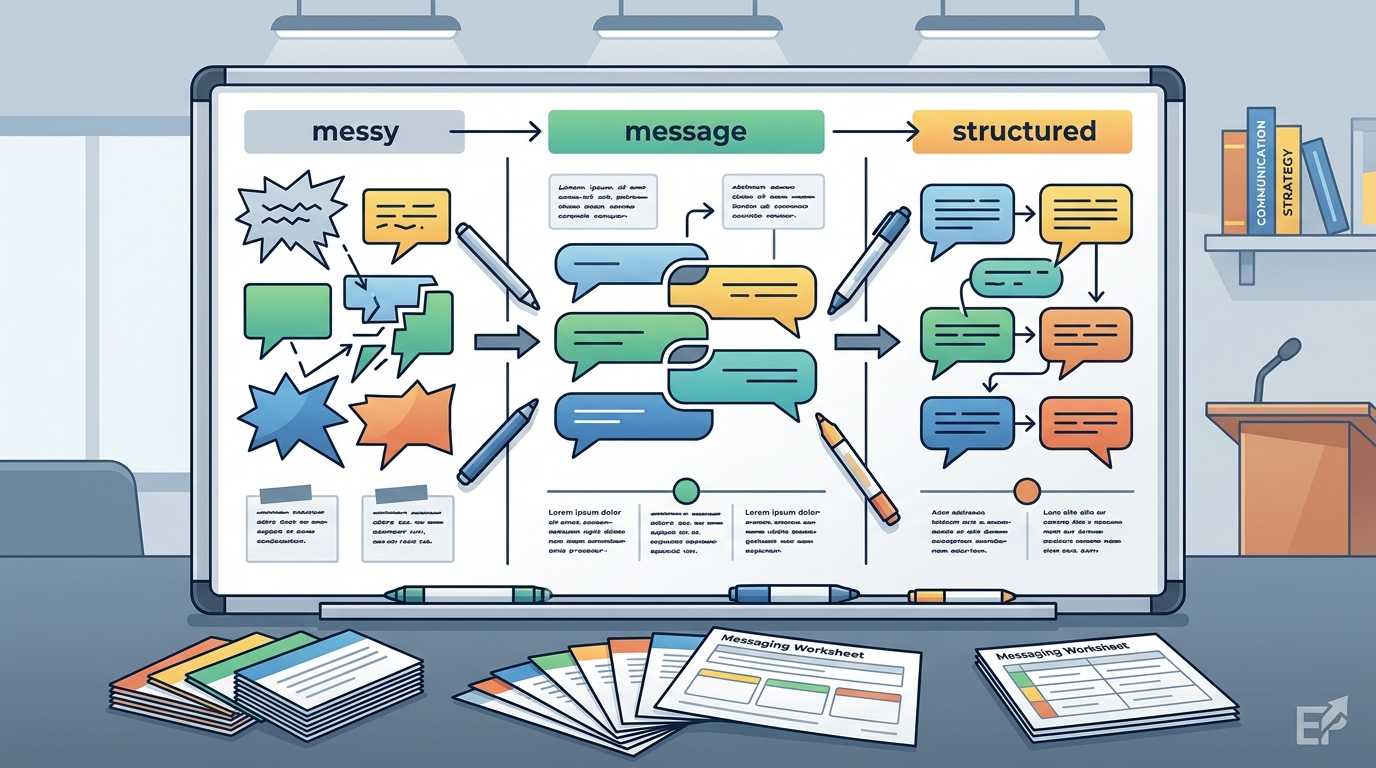
The most effective teams do not just tell people to "communicate better." They give them a structure. A strong framework includes three components: a clear opening that states the purpose, a logical body that supports the point, and a close that drives action.
| Component | What It Does | Common Mistake |
|---|---|---|
| Opening | States the purpose so the audience immediately knows what you need | Burying the point under background info |
| Body | Supports the point with evidence at the right level of detail | Over-explaining or rambling |
| Close | Drives a decision or specific next step | Trailing off without a clear ask |
Effective Presentations teaches a messaging structure that helps professionals lead with context, state their point early, and support it without over-explaining. This structure works for pitches, leadership updates, cross-functional meetings, and day-to-day emails alike.
Step 3: Practice with Coached Feedback
Knowing a framework and using it under pressure are two very different things. That is why the best communication training is built around coached practice, not lectures. Participants present, receive direct feedback, and apply adjustments before leaving the room.
Why Practice Beats Theory
Professionals who present frequently often have habits they have never received honest feedback on. A coached environment gives them specific, actionable adjustments that sharpen delivery and tighten the message. Effective Presentations' team training programs are built around this model, with small-group sessions capped at 10 participants for maximum coaching time.
Virtual and On-Site Options
For distributed teams, live virtual training delivers the same coached practice experience through a structured online format. Virtual sessions are capped at five participants, ensuring every person gets individual attention.
Step 4: Adapt Messaging for Different Audiences
A message that works for your engineering team will not work for the C-suite. Audience adaptation is the skill of adjusting your structure, vocabulary, and level of detail based on who is listening.
Technical experts, for example, need to translate complex ideas into clear narratives so non-technical stakeholders can follow and make decisions. Sales teams need to frame value in the buyer's language, not their own. Short masterclasses can target these specific gaps in one- or two-hour focused sessions.
Step 5: Sustain Improvement Over Time
One workshop will not permanently change behavior. Sustained improvement requires reinforcement. Here is what high-performing teams do after initial training:
- Schedule monthly "messaging check-ins" where team members practice short updates using the framework
- Pair new hires with trained communicators for onboarding
- Use follow-up coaching sessions to address individual gaps
- Measure progress by tracking meeting length, email threads, and decision speed
Effective Presentations includes a private one-on-one follow-up coaching session with every individual enrollment so that improvement continues after the workshop ends.
Key Takeaways
- Poor communication costs U.S. businesses up to $1.2 trillion annually and $10,000 to $55,000 per employee per year.
- Message refinement is a coachable, repeatable skill, not a personality trait.
- A shared messaging framework gives every team member a common structure for organizing ideas.
- Coached practice with direct feedback produces faster, more lasting improvement than lecture-based training.
- Audience adaptation means adjusting your structure and vocabulary for each stakeholder group.
- Sustained improvement requires follow-up coaching, reinforcement rituals, and measurable benchmarks.
- Teams that invest in messaging clarity make faster decisions, run shorter meetings, and build stronger cross-functional trust.
Frequently Asked Questions
What is team messaging refinement?
Team messaging refinement is the process of systematically improving how a group structures, delivers, and adapts its communication so every message is clear, concise, and actionable.
How much does poor communication cost a business?
According to Grammarly's 2025 report, poor communication costs U.S. businesses up to $1.2 trillion per year. On a per-employee basis, Axios HQ estimates the cost ranges from $10,000 to $55,000 annually.
What is a shared messaging framework?
A shared messaging framework is a reusable structure that gives team members a common approach to organizing ideas, typically including a clear opening, a supported body, and an action-oriented close.
Can messaging skills be trained virtually?
Yes. Live virtual training programs deliver coached practice and real-time feedback through structured online sessions. Effective Presentations offers virtual sessions capped at five participants to maintain coaching quality.
How long does it take to see results from messaging training?
Most participants notice improvement immediately after a two-day workshop. Lasting behavior change typically solidifies over four to six weeks with follow-up coaching and practice.
Is messaging training only for executives?
No. Cross-functional teams that include executives, managers, and individual contributors all benefit. Programs are tailored so everyone improves together using a shared framework and common language.
What is the difference between delivery training and messaging training?
Delivery training focuses on how you speak: voice, presence, body language, and confidence. Messaging training focuses on what you say: structure, clarity, and audience relevance. The best results come from combining both.
How do I get started with team messaging training?
Start by auditing where unclear communication costs your team time. Then explore a structured program like Effective Presentations' Messaging and Structure workshop to build the skills across your group.
Ready to Sharpen Your Team's Messaging?
If unclear communication is costing your team time, trust, or results, it is time to build the skill that fixes it. Explore Effective Presentations' team training programs and give your team a shared framework for messaging that sticks. Call 800-403-6598 or request a proposal online to get started.