

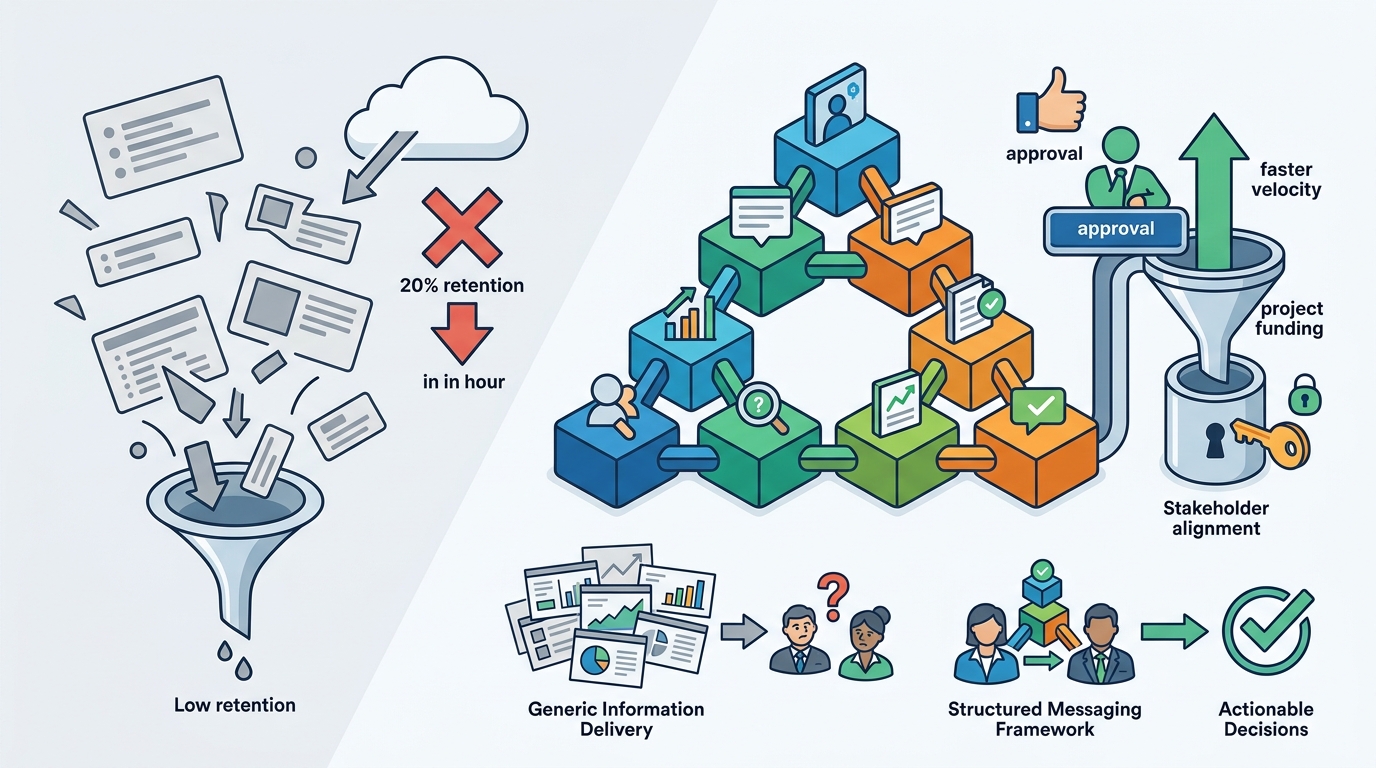
Research indicates that audiences retain only twenty percent of standard corporate messaging within the first hour of delivery. This retention gap directly impacts decision-making velocity and project funding across enterprise environments. Organizations that implement structured messaging frameworks consistently report higher stakeholder alignment and faster approval cycles. The solution requires moving beyond generic information delivery to focus on psychological triggers and structural clarity. You must architect your core narrative around verified audience pain points and measurable outcomes. This strategic pivot guarantees measurable business impact. Harvard Business Review confirms that targeted communication strategies directly correlate with executive budget approvals.
Define Your Core Objective
Every successful presentation begins with a singular, unshakable goal. You must determine exactly what action you want your audience to take after the session concludes. Audience resonance is the measurable alignment between your core message and the specific psychological triggers of your listeners. When you align your objective with their immediate priorities, you eliminate noise and accelerate comprehension. Start by mapping your primary request against their current operational challenges. This alignment prevents information overload and keeps the conversation focused on actionable outcomes.
Clarify Your Primary Request
State your request in a single sentence before drafting any supporting materials. Vague objectives create vague outcomes. Executives and stakeholders respond to direct, unambiguous language. Replace abstract concepts with concrete deliverables. Your audience needs to understand the exact value proposition within the first three minutes. This clarity reduces cognitive friction and increases retention rates across complex technical briefings.
Align With Stakeholder Priorities
Review your audience profile to identify their pressing operational bottlenecks. Map your proposed solution directly to those bottlenecks. When your request solves a verified pain point, resistance naturally decreases. You can leverage our Messaging Structure framework to map these priorities systematically. This method ensures your core request remains visible throughout the entire presentation lifecycle.
Identify Audience Needs
Understanding your listeners requires more than basic demographic data. You must analyze their current knowledge level, emotional state, and decision-making authority. Messaging architecture is the systematic organization of arguments, evidence, and calls to action designed to guide decision-making. This architectural approach prevents you from drowning high-level executives in granular technical details. It also prevents you from oversimplifying complex engineering briefings for technical reviewers. Balance depth with accessibility by segmenting your content into tiered information layers.
Assess Knowledge Gaps
Identify the exact information your audience lacks before they can approve your proposal. Provide only the data required to bridge that specific gap. Extra information dilutes your core argument and increases the risk of misinterpretation. Use targeted questions during the opening minutes to verify comprehension levels. Adjust your pacing and terminology based on real-time feedback. This adaptive approach keeps the presentation tightly aligned with audience expectations.
Address Emotional Barriers
Decision-makers often resist new initiatives due to perceived risk or resource constraints. Acknowledge these concerns directly rather than ignoring them. Validate their hesitation with concrete examples from similar industry transitions. When you address emotional barriers early, you build trust and reduce defensive reactions. This psychological safety allows your audience to focus on the logical merits of your proposal. You can explore advanced coaching techniques through our Ultimate Communicator Program to master these emotional alignment tactics.
Structure Your Narrative
A logical flow transforms scattered data into a compelling argument. You must arrange your points in a sequence that mirrors the audience decision process. Persuasive messaging is the strategic deployment of verified data and emotional framing to drive stakeholder commitment. This definition highlights the necessity of combining hard metrics with relatable context. Structure your presentation using a problem-solution-impact framework. This proven sequence guides listeners from current frustrations to future benefits without losing momentum.
Establish The Current Problem
Open with a clear description of the existing operational inefficiency. Use recent performance metrics to quantify the financial or operational cost of inaction. Data shows that organizations ignoring current inefficiencies lose an average of fifteen percent in annual revenue growth. Simon Sinek emphasizes that leaders must first explain the why before presenting the how. Apply this principle by framing the problem as a shared challenge rather than a personal failure. This shared framing increases collaborative problem-solving and reduces defensive posturing.
Present The Verified Solution
Introduce your proposed strategy immediately after establishing the problem. Highlight the specific mechanisms that will resolve the identified inefficiency. Avoid speculative language and focus on proven methodologies. Reference case studies from similar industries to demonstrate feasibility. Your audience needs concrete proof that your solution works under real-world constraints. This evidence-based approach builds credibility and accelerates the approval timeline.
Quantify The Future Impact
Translate your solution into measurable business outcomes. Project the exact financial savings, time reductions, or efficiency gains your audience will experience. Provide a clear timeline for implementation and expected return on investment. Stakeholders approve initiatives that demonstrate predictable, quantifiable returns. Use visual aids to reinforce these numerical projections. Clear visual data reduces ambiguity and strengthens your final recommendation.
Deliver With Clarity
Delivery mechanics determine whether your structured message lands effectively. You must synchronize your verbal content with your visual aids and body language. Inconsistent delivery creates cognitive dissonance and undermines your credibility. Practice your presentation using recorded feedback sessions to identify delivery gaps. This iterative refinement process ensures your verbal and non-verbal signals reinforce each other. You can schedule a targeted workshop to practice these delivery techniques in a controlled environment.
Synchronize Verbal And Visual Cues
Ensure every slide supports your spoken narrative without duplicating it. Use visuals to illustrate complex relationships or highlight critical data points. Avoid reading directly from your slides, as this creates passive listening habits. Instead, use your slides as visual anchors while you provide the contextual explanation. This separation of roles keeps your audience engaged and focused on your expertise. Consistent synchronization prevents information overload and maintains presentation momentum.
Manage Pacing And Pauses
Strategic pauses allow your audience to process complex information before you move forward. Rushing through critical points increases the likelihood of misinterpretation. Slow your delivery during high-stakes data presentations to emphasize importance. Use deliberate pacing to signal transitions between major arguments. This controlled tempo gives listeners time to absorb your core concepts. It also projects confidence and reinforces your authority on the subject matter.
Measure Audience Resonance
Measuring resonance requires tracking specific behavioral and verbal indicators during your presentation. You must observe engagement levels, question quality, and post-session follow-up actions. High resonance correlates with immediate stakeholder commitment and reduced revision cycles. Track these metrics to refine your messaging framework for future engagements. This continuous improvement loop ensures your presentations consistently drive desired outcomes. Review our case studies to see how top performers track these exact resonance metrics.
Track Engagement Indicators
Monitor eye contact, note-taking frequency, and body language shifts throughout your session. Active engagement signals that your message aligns with audience priorities. Passive listening or distracted behavior indicates a misalignment in your core argument. Adjust your pacing or reframe your explanation when you detect these warning signs. Real-time adaptation prevents the presentation from derailing before the conclusion. This adaptive strategy maximizes your chances of securing immediate buy-in.
Evaluate Post-Session Actions
Track the specific follow-up requests, budget approvals, or implementation timelines your audience initiates. High follow-up rates directly correlate with successful message resonance. Low follow-up rates indicate a failure in your problem-solution alignment. Analyze these outcomes to identify which messaging components require adjustment. This data-driven refinement process strengthens your future presentations. Consistent tracking transforms subjective feedback into objective performance benchmarks.
Optimize For Long-Term Impact
Sustained impact requires integrating your presentation messaging into broader organizational communication strategies. You must ensure your core arguments align with company-wide messaging standards and compliance requirements. Inconsistent messaging across departments creates confusion and delays project execution. Standardize your terminology and data visualization formats across all internal communications. This standardization reinforces your core message and accelerates cross-departmental alignment. Organizations that maintain consistent messaging frameworks report a twenty percent increase in cross-functional project velocity. American Psychological Association confirms that consistent messaging reduces workplace cognitive load and improves decision accuracy.
Standardize Terminology
Develop a shared glossary for complex project terms and industry-specific jargon. Ensure all team members use identical definitions during client interactions and internal reviews. Terminology inconsistencies create miscommunication and damage professional credibility. Distribute this glossary to all stakeholders before major presentation cycles. This shared vocabulary eliminates ambiguity and strengthens your organizational authority. Consistent terminology also simplifies training for new team members joining active projects.
Integrate Feedback Loops
Establish structured feedback channels to capture audience reactions after every major presentation. Use surveys, direct interviews, and performance metrics to gather actionable insights. Analyze this feedback to identify recurring messaging strengths and weaknesses. Implement these insights into your next presentation draft immediately. This continuous integration process ensures your messaging evolves alongside audience expectations. Regular optimization keeps your communication strategies relevant and highly effective.
Compare Messaging Frameworks
| Framework Type | Primary Focus | Best Use Case | Implementation Path |
|---|---|---|---|
| Traditional Data Dump | Information volume and technical completeness | Internal compliance audits and archival records | Standard Training |
| Resonant Narrative | Psychological alignment and emotional framing | Executive pitches and client acquisition | Messaging Structure |
| Impact-Driven Strategy | Quantifiable outcomes and implementation timelines | Budget approvals and cross-departmental rollouts | Ultimate Program |
Key Takeaways
- Audiences retain only twenty percent of standard corporate messaging within the first hour of delivery.
- Organizations implementing structured messaging frameworks report higher stakeholder alignment and faster approval cycles.
- Stakeholders approve initiatives that demonstrate predictable, quantifiable returns on investment.
- Organizations maintaining consistent messaging frameworks report a twenty percent increase in cross-functional project velocity.
- High follow-up rates directly correlate with successful message resonance and immediate buy-in.
- Strategic pauses allow audiences to process complex information before moving forward.
- Real-time adaptation prevents presentations from derailing before the conclusion.
Frequently Asked Questions
How do I know if my message is actually persuasive?
Track specific behavioral indicators like immediate follow-up requests, budget approvals, and implementation timelines. High follow-up rates directly correlate with successful message resonance. Low follow-up rates indicate a failure in your problem-solution alignment. Analyze these outcomes to identify which messaging components require adjustment.
What is the most effective way to structure a persuasive presentation?
Use a problem-solution-impact framework that guides listeners from current frustrations to future benefits. This proven sequence keeps audiences engaged while delivering complex information. Structure your presentation using verified data and emotional framing to drive stakeholder commitment. This approach minimizes cognitive friction and accelerates decision-making.
How can I address emotional barriers without compromising data integrity?
Validate audience hesitation with concrete examples from similar industry transitions. Acknowledge these concerns directly rather than ignoring them during the presentation. When you address emotional barriers early, you build trust and reduce defensive reactions. This psychological safety allows your audience to focus on the logical merits of your proposal.
What metrics should I track to measure audience resonance?
Monitor eye contact, note-taking frequency, and body language shifts throughout your session. Active engagement signals that your message aligns with audience priorities. Passive listening or distracted behavior indicates a misalignment in your core argument. Adjust your pacing or reframe your explanation when you detect these warning signs.
How often should I update my messaging framework?
Review your messaging framework after every major presentation cycle using structured feedback channels. Use surveys, direct interviews, and performance metrics to gather actionable insights. Analyze this feedback to identify recurring messaging strengths and weaknesses. Implement these insights into your next presentation draft immediately.
Can I use the same persuasive message for technical and executive audiences?
Balance depth with accessibility by segmenting your content into tiered information layers. Executive audiences require high-level financial projections and strategic outcomes. Technical audiences require granular implementation details and compliance metrics. Tailor your messaging architecture to match the specific knowledge level of each group.
What role does delivery pacing play in message retention?
Strategic pauses allow your audience to process complex information before you move forward. Rushing through critical points increases the likelihood of misinterpretation. Slow your delivery during high-stakes data presentations to emphasize importance. Use deliberate pacing to signal transitions between major arguments.
Ready To Transform Your Presentations?
Stop leaving critical stakeholder decisions to chance. Our proven messaging frameworks and targeted coaching programs equip your team with the exact tools needed to deliver high-impact presentations consistently. Schedule a free consultation with our lead trainers today to map your specific communication challenges. Visit our contact page to book your personalized strategy session. Transform your next presentation into a measurable business advantage.