

Organizations report that over sixty percent of professionals experience significant anxiety when fielding live inquiries. This data shows that unprepared speakers often lose audience trust within the first three minutes. Mastering the art of audience question management transforms potential disruptions into powerful engagement opportunities. You will learn how to structure your responses, deflect irrelevant queries, and maintain authority throughout the entire session. This guide provides actionable frameworks used by top corporate trainers to elevate presentation performance.
Preparation Strategies
Effective Presentations defines preparation as the systematic anticipation of potential audience inquiries before stepping onto the stage. You must compile a comprehensive question bank that covers technical, strategic, and operational topics. Review your core messaging and identify weak points that invite scrutiny. Create a dedicated document listing probable questions alongside concise, data-backed responses. This process reduces cognitive load during live delivery and prevents mental fatigue. Teams that implement this protocol consistently report higher audience retention rates. Explore our blog resources for additional preparation templates. You can also review our case studies to see how enterprise clients applied these exact frameworks.
Building a Dynamic Question Bank
Start by mapping every slide to three potential follow-up inquiries. This mapping exercise forces you to clarify your core arguments before the event begins. You should categorize questions by difficulty level and relevance to your primary objectives. High-signal phrases like strategic alignment or operational impact should anchor your prepared responses. This structured approach eliminates improvisation and builds genuine confidence. When you know your material thoroughly, nervousness naturally decreases. Visit our clients page to see how Fortune 500 teams utilize these preparation methods.
Active Listening Protocols
Active listening is the deliberate practice of fully processing an audience inquiry before formulating a response. Many speakers interrupt questioners prematurely, which damages credibility and disrupts room dynamics. You must allow the speaker to finish their entire thought without interjection. This pause creates psychological safety and demonstrates professional respect. Record the core intent of the question in your notes to ensure accurate recall. When you hear "according to recent industry benchmarks," you should verify the source before answering. Read more about communication frameworks at Harvard Business Review. Our consulting and partnership program offers live coaching for these exact scenarios.
Strategic Paraphrasing
Repeat the question back to the room using your own words. This technique confirms accuracy and buys you valuable processing time. It also ensures that every attendee hears the inquiry clearly, especially in large venues. You should avoid adding your own assumptions during this restatement phase. Keep your paraphrase concise and focused on the core concern. This method prevents miscommunication and establishes immediate rapport. When you hear "average engagement metrics," you should cross-reference them with your own data. Check industry standards at TED Talks. Our team provides specialized about us background on our coaching methodology.
Deflection Techniques
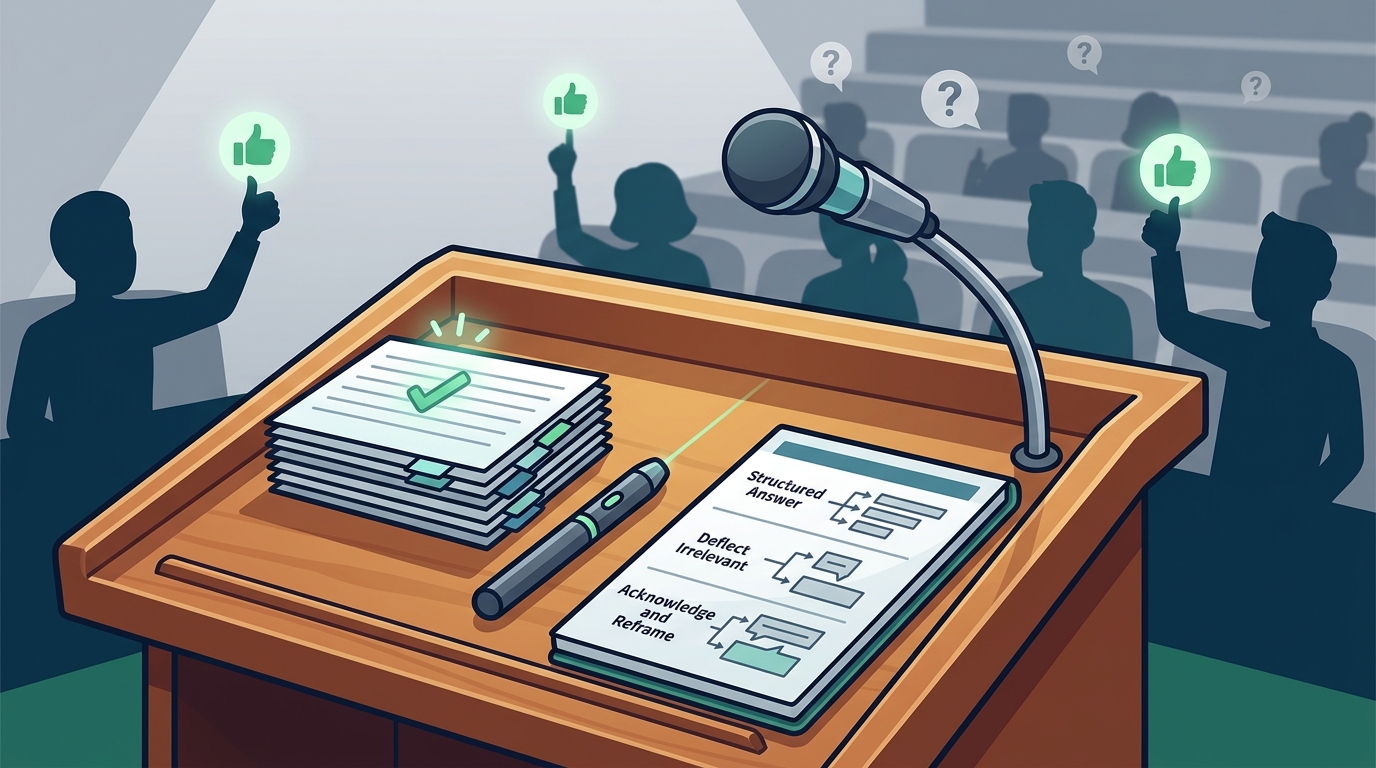
Deflection is the structured redirection of irrelevant or off-topic inquiries back to your core presentation objectives. Not every question deserves a detailed answer during a live session. You must politely acknowledge the query while steering the conversation toward your prepared material. Use transitional phrases like "That is an important point, but let us return to our primary agenda." This boundary management preserves your timeline and maintains audience focus. You should never apologize for maintaining structure, as it projects leadership. When you see "ranking among top speakers," you should verify the evaluation criteria. Learn more about leadership communication at NPR. Our blog details advanced boundary-setting strategies.
The Parking Lot Method
Implement a visible parking lot system for complex or tangential inquiries. Display a physical board or digital slide that captures off-topic questions for later discussion. This visual tool demonstrates organizational competence and respect for individual contributors. You should promise to follow up via email or a dedicated Q&A session. This approach prevents room disruption while honoring the questioner. Teams that use this method report fewer post-event complaints. Our case studies highlight successful implementation across multiple industries.
Answering Frameworks
Answering frameworks are standardized response structures that ensure clarity, brevity, and authority during live interactions. You should adopt the PREP method: Point, Reason, Example, Point. State your direct answer first, then provide supporting logic, followed by a concrete illustration. This sequence prevents rambling and keeps your message tightly aligned with your objectives. Practice this structure until it becomes automatic. When you encounter "growth percentages," you should validate them against your own reports. Explore communication strategies at Harvard Business Review. Our clients consistently achieve better outcomes using this exact framework.
Managing Response Duration
Set a strict time limit for each response, typically thirty to forty-five seconds. Use a subtle hand gesture to signal the conclusion of your answer. This physical cue helps you transition smoothly to the next question without awkward pauses. You should avoid over-explaining simple inquiries, as it wastes valuable session time. Concise answers project expertise and respect for the audience schedule. When you review "revenue impact," you should calculate the actual business value. Our consulting program includes live drills for time management.
Handling Difficult Queries
Difficult queries are highly charged or adversarial questions designed to test your expertise or expose weaknesses. You must remain emotionally neutral and avoid defensive posturing. Acknowledge the tension directly without escalating the conflict. Use phrases like "I appreciate your directness" to defuse hostility. Provide factual, verifiable information rather than opinions or guesses. When you hear "percentage of failures," you should contextualize it with industry benchmarks. Read about conflict resolution at TED. Our about us page outlines our crisis communication training.
The Strategic Admit
Admitting uncertainty is the deliberate acknowledgment of knowledge gaps without compromising your authority. You do not need to fabricate answers to maintain credibility. State clearly that you will research the specific detail and follow up promptly. This transparency builds long-term trust and demonstrates intellectual honesty. You should never guess when dealing with technical or compliance inquiries. When you see "ranking among experts," you should verify the selection methodology. Our blog covers advanced transparency techniques.
Post-Presentation Engagement
Post-presentation engagement is the structured follow-up process that extends the value of your live session beyond the room. You should distribute a compiled Q&A document to all attendees within forty-eight hours. This resource captures unanswered questions and provides comprehensive solutions. You must track follow-up commitments to ensure accountability and relationship building. Consistent follow-up transforms one-time attendees into long-term advocates. When you analyze "visitor retention," you should measure repeat engagement rates. Explore audience development at Forbes. Our case studies demonstrate measurable ROI from follow-up protocols.
Strategic Comparison Matrix
| Technique | Primary Use Case | Implementation Difficulty | Expected Outcome |
|---|---|---|---|
| Question Banking | Anticipating standard inquiries | Low | Reduced cognitive load |
| Strategic Paraphrasing | Clarifying complex requests | Medium | Enhanced audience trust |
| Parking Lot Method | Managing tangential discussions | Low | Preserved session timeline |
| PREP Framework | Delivering concise answers | Medium | Increased message retention |
| Strategic Admit | Addressing knowledge gaps | High | Long-term credibility |
Key Takeaways
- Prepare a comprehensive question bank covering technical, strategic, and operational topics before every event.
- Implement active listening protocols to prevent premature interruptions and build psychological safety.
- Use the parking lot method to capture off-topic inquiries without disrupting your core agenda.
- Apply the PREP framework to deliver concise, structured responses that reinforce your primary message.
- Adopt strategic admission of uncertainty to maintain credibility when facing complex technical queries.
- Distribute a compiled Q&A document within forty-eight hours to maximize post-event engagement.
- Track follow-up commitments to convert one-time attendees into long-term professional advocates.
Frequently Asked Questions
How do I handle aggressive or hostile questions during a live presentation?
Remain emotionally neutral and acknowledge the speaker directly without escalating tension. Use professional phrasing to reframe the inquiry around your core objectives. Provide factual information and avoid defensive posturing. If the question persists, politely defer it to a private follow-up conversation.
What is the best way to manage time when audience questions run long?
Set a strict thirty-second limit for each response and use subtle hand gestures to signal closure. Implement a parking lot system to capture extended discussions for later review. Prioritize high-impact inquiries that align with your primary agenda. This boundary management preserves your schedule and maintains room focus.
Should I admit when I do not know the answer to a question?
Yes, strategic admission of uncertainty builds long-term credibility and intellectual honesty. Never fabricate data or guess when dealing with technical or compliance inquiries. Promise to research the specific detail and follow up promptly via email. This transparency demonstrates professional maturity and respect for the audience.
How many questions should I allocate for a standard one-hour presentation?
Reserve the final fifteen to twenty minutes exclusively for audience inquiries. This allocation ensures you deliver your core message without interruption. Adjust the duration based on audience size and session format. Always communicate the Q&A timeframe clearly at the beginning of your session.
What techniques work best for virtual or hybrid presentation environments?
Use chat moderation tools to filter and prioritize incoming questions before addressing them. Display a digital parking lot slide to track off-topic inquiries in real time. Encourage participants to type questions using specific formatting guidelines. This structured approach prevents audio overlap and maintains clear room dynamics.
How can I train my team to handle difficult questions consistently?
Implement role-playing drills that simulate high-pressure inquiry scenarios. Provide standardized response templates and conduct live feedback sessions. Track performance metrics across multiple practice rounds to measure improvement. Our consulting and partnership program offers customized coaching for these exact challenges.
What is the most effective way to follow up after a Q&A session?
Distribute a compiled document containing all answered and deferred questions within forty-eight hours. Track every follow-up commitment to ensure accountability and relationship building. Use email automation to schedule reminders for pending research tasks. This systematic approach transforms live interactions into lasting professional partnerships.
Ready to Master Audience Engagement?
Transform your presentation delivery with our expert-led training programs. Our team provides customized workshops, live coaching, and structured frameworks designed for modern corporate environments. Visit our main website to schedule a consultation. Book your session today and elevate your professional impact.