

Audience questions are not an interruption to a strong presentation; they are evidence that people are listening, evaluating your ideas, and deciding how your message applies to their situation. The challenge is that Q&A requires a different communication skill from delivering prepared remarks. You must listen carefully, think quickly, answer clearly, and keep the room aligned with your purpose.
The most effective presenters do not rely on improvisation alone. They prepare for likely questions, establish expectations, create thinking time, use a repeatable response structure, and know when to answer, defer, or redirect. This guide explains how to do that in meetings, sales presentations, executive briefings, conferences, webinars, and other high-stakes speaking situations.
Effective Presentations helps professionals build the practical skills behind clear, confident, and credible communication. Learn more about the team and its approach on the About Effective Presentations page.
Key Takeaways
- Audience questions provide feedback about what listeners understood, value, doubt, or want to explore further.
- Prepare a question bank before the presentation, including objections, missing details, implementation concerns, and sensitive issues.
- Listen to the complete question, pause briefly, and repeat or paraphrase it when clarification or audibility would help.
- Answer with a clear point, supporting reason or evidence, relevant example, and concise conclusion.
- Do not guess when you lack reliable information. A specific follow-up commitment is more credible than speculation.
- Use a parking lot, bridge, or private follow-up when a question is outside the presentation’s scope or threatens the schedule.
- End with a short reinforcing message so the final idea the audience hears supports your presentation objective.
1. Prepare for the Questions Before You Present
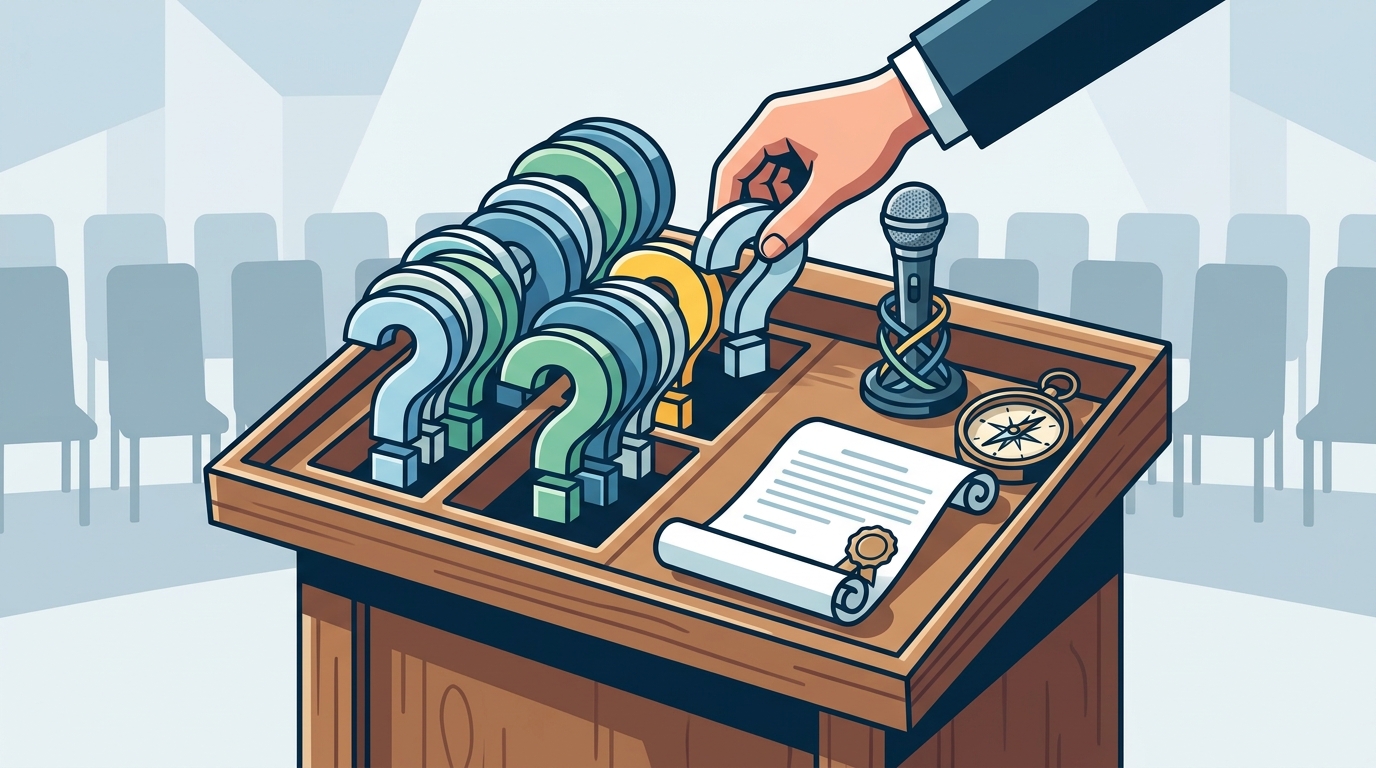
Strong Q&A begins during presentation planning, not when someone raises a hand. Review your outline and identify every point that could prompt uncertainty, disagreement, or a request for more detail. Then build a question bank with short, spoken answers rather than paragraphs you intend to memorize.
Useful categories include:
- Clarification: “What does this term mean?” or “How does this process work?”
- Evidence: “What data supports this recommendation?”
- Application: “How would this work for our team or customers?”
- Risk: “What could go wrong, and how would we manage it?”
- Comparison: “Why choose this option instead of the alternative?”
- Cost and resources: “What budget, time, or staffing would this require?”
- Challenge: “What assumption is this conclusion based on?”
Ask a colleague to review the question bank from the perspective of a skeptical customer, executive, employee, or technical expert. Practicing likely questions makes your delivery more polished without making it sound scripted. It also helps you find gaps in the presentation itself. If the same question repeatedly appears in rehearsal, consider answering it proactively in the main talk.
Address the obvious concern instead of hiding it
If you know a sensitive topic will dominate the audience’s attention, decide whether to address it before the Q&A begins. Acknowledging a major concern directly can prevent the audience from concluding that you are avoiding it. For example, a project leader presenting a new software rollout might say, “Before we discuss the benefits, let’s address the implementation risk: the first four weeks will require additional manager support.”
2. Set Q&A Expectations Early
Audience behavior is easier to manage when the process is clear. At the beginning of the presentation, explain whether questions are welcome throughout the talk or reserved for a designated Q&A period. Tell participants how to ask questions in the room or online, and explain how you will handle questions that require more time.
A simple opening might be: “I’ll take clarification questions as we go, and we’ll reserve the final ten minutes for broader discussion. If a question requires data I do not have with me, I’ll capture it and follow up after the meeting.”
For a large or formal event, add practical ground rules: one question at a time, a brief introduction if relevant, and a limit on follow-up questions when time is tight. These guidelines are not restrictive; they protect access for the whole audience. Q&A guidance from Toastmasters similarly emphasizes explaining how the session will proceed and setting expectations that are easy to enforce. Source: Toastmasters International guidance on handling question-and-answer sessions.
Choose the right timing model
- Questions throughout: Best for workshops, small meetings, and technical collaboration where interaction improves understanding.
- Questions at the end: Best when the presentation has a carefully sequenced argument or when interruptions could create significant tangents.
- Hybrid approach: Invite brief clarification questions during the presentation while saving strategic or detailed questions for the end.
3. Listen, Pause, and Repeat or Paraphrase
The most common Q&A mistake is answering too quickly. Speakers sometimes begin responding before the question is complete, then discover that they addressed the wrong issue. A reliable sequence is: listen fully, pause, confirm the question, and respond.
- Listen: Keep your attention on the questioner instead of planning your answer while they are still speaking.
- Pause: Take one or two natural breaths. A short pause gives you time to identify the central issue and choose a response structure.
- Repeat or paraphrase: Restate the question when the room may not have heard it, when the wording is ambiguous, or when you want to confirm your interpretation.
- Respond: Give the shortest complete answer that serves the audience.
For example: “If I understand you correctly, you are asking how we will measure adoption during the first quarter. The primary measure will be weekly active use, supported by manager feedback and completion data.”
Repeating a question is especially useful in a large conference room or virtual meeting where audio may be uneven. It also gives the wider audience the context they need to understand your answer. The University of Pennsylvania’s Wharton Communication Program recommends pausing to ensure understanding, stating a position clearly, supporting it with evidence, and concluding without over-answering. Source: Wharton Communication Program guidance on handling Q&A.
4. Use a Concise Answer Structure
When an answer has no visible shape, audiences can lose the main point even when the information is accurate. Use a simple four-part structure to make your response easy to follow:
- Point: Answer the question directly in the first sentence.
- Reason: Explain why that answer is appropriate.
- Example or evidence: Add one data point, scenario, comparison, or short case example.
- Close: Restate the practical conclusion and stop.
Suppose someone asks, “Why are we changing the client onboarding process?” A concise response could be:
Point: “We are changing it to reduce the time between contract signature and the client’s first successful use of the service.” Reason: “The current process creates delays because information is handed between too many teams.” Example: “In the last quarter, three common handoffs added an average of five business days.” Close: “The new process assigns one owner from kickoff through activation.”
This structure resembles the PREP approach—point, reason, example, point—but it is flexible enough for executive, sales, technical, and internal presentations. For a simple question, the answer may take 20 seconds. For a complex question, you can add one layer of detail without losing the central message.
Know when to stop
Many presenters damage a strong answer by continuing after they have already responded. Watch for signs that the answer is complete: the questioner nods, the audience’s attention returns to you, or you have stated the implication clearly. Finish with a phrase such as “That is the main reason,” “So the practical implication is…,” or “That is how we plan to manage the risk.” Then invite the next question.
5. Match Your Response to the Question
Not all questions are asking for the same kind of response. Identify the question’s intent before choosing your words.
| Question type | What the person needs | Useful response approach |
|---|---|---|
| Clarification | A simpler definition or missing detail | Explain the term plainly and provide a brief example. |
| Challenge | Evidence, assumptions, or risk analysis | Acknowledge the concern, state your position, and support it with relevant evidence. |
| Application | How the idea affects their situation | Translate the concept into steps, decisions, or outcomes for their context. |
| Exploration | More depth or possibilities | Answer briefly, then identify the next area worth discussing. |
| Objection | Reassurance or a reason to reconsider | Validate the concern without conceding an unsupported premise, then explain the trade-off. |
| Off-topic | A separate issue or personal agenda | Recognize it, connect it to the appropriate channel, and redirect. |
For instance, a clarification question such as “What do you mean by faster approval?” should not receive a defensive answer. Define the measure. Conversely, a challenge such as “What happens if adoption is lower than expected?” deserves a risk response with assumptions, thresholds, and contingency actions.
6. Handle Questions You Cannot Answer Honestly
You do not need to know everything to appear credible. You do need to distinguish between what you know, what you estimate, and what requires verification. Guessing is risky because an inaccurate answer can undermine confidence in information you presented correctly.
Use this five-step response:
- Thank the person for raising the question.
- State clearly what you do not know or cannot confirm.
- Share any relevant information you can verify without speculating.
- Commit to a specific follow-up action and timeframe.
- Record the person’s name and contact information so the commitment is not lost.
Example: “That is an important question. I do not have the confirmed regional breakdown with me, so I do not want to guess. I can verify it with our analytics team and send you the figures by Thursday afternoon. May I get your email before we move on?”
The original Effective Presentations guidance also recommends acknowledging the gap, researching the answer, collecting contact information, and following up after the presentation. Source: Effective Presentations article on answering audience questions appropriately.
Be precise with your promise. “I’ll get back to you soon” creates uncertainty. “I’ll send the verified figures by 3 p.m. Friday” creates accountability.
7. Redirect Hostile, Lengthy, or Off-Topic Questions
A difficult question is not always a hostile question. Some people are frustrated, some are highly detailed, and some are trying to move the conversation toward an issue that matters to them but does not serve the current objective. Your job is to protect the quality and purpose of the discussion without embarrassing the questioner.
For a hostile question
Separate the emotion from the claim. Acknowledge the concern without accepting an accusation as fact.
Try: “I can hear that the missed deadline created a serious concern. The cause was a vendor dependency, and the corrective action is a revised approval checkpoint. Let me explain what changes from here.”
Avoid sarcasm, visible irritation, or a point-by-point argument with the person. The rest of the audience is evaluating your composure as much as your content.
For a long or multi-part question
Summarize the central question and answer that first. You might say, “I’m hearing two issues: timing and staffing. I’ll address timing first, then we can decide whether staffing needs a separate discussion.” If the person continues, use a respectful boundary: “I want to make sure others have time, so let me answer the core point and then we can continue after the session.”
For an off-topic question
Use a three-part redirect:
- Acknowledge: “That is related to the broader implementation discussion.”
- Set the boundary: “It is outside today’s decision about launch readiness.”
- Offer a path: “I’ll add it to the follow-up list, and we can review it with the operations team.”
The parking lot method is useful when several questions deserve attention but cannot be answered without derailing the presentation. Write them visibly on a board, shared document, or moderator’s list, then state when and how they will be addressed.
8. Use Visual Aids and Examples Strategically
Slides should not replace your explanation, but a well-designed backup slide can make a complex answer more concrete. Prepare a small set of appendix slides for questions about data, timelines, process steps, assumptions, comparisons, and implementation details.
For most professional presentations, three to five focused backup slides are more useful than a large appendix. Each slide should have a descriptive headline, readable labels, and only the information needed to support the answer. Avoid displaying a dense spreadsheet and expecting the audience to interpret it while you speak.
Use a transition that tells the audience why you are changing the visual: “I have one appendix slide that shows how that number was calculated.” Then point to the relevant area, explain the implication, and return to the main discussion. Practice navigating to these slides so technology does not become the focus of the exchange.
If no slide is necessary, use a verbal example instead. A short scenario often clarifies a process better than a lengthy definition: “Imagine a manager receives the request on Monday. Under the new workflow, the request is triaged that day, assigned Tuesday, and reviewed by Thursday.”
9. Close the Session and Follow Up
A Q&A session should have a deliberate ending. When time is nearly finished, announce it: “We have time for one final question.” After answering, summarize the message you want attendees to remember and tell them what happens next.
For example: “The key point is that the recommendation is designed to reduce approval delays without removing review controls. I’ll send the supporting analysis and the two unanswered questions to the group tomorrow.”
Follow up within the timeframe you promised. A useful follow-up message can include:
- Answers to questions that required research.
- Links to relevant documentation or supporting analysis.
- A correction if something stated live was incomplete or inaccurate.
- Owners and deadlines for unresolved decisions.
- An invitation for a focused conversation when a topic needs more privacy or depth.
Review the questions afterward. They reveal more than what people want to know; they show where your message was unclear, where evidence was insufficient, and which concerns may affect adoption or decision-making. Add recurring questions to your presentation, FAQ, proposal, or manager toolkit.
A Practical Q&A Rehearsal Drill
Use this 20-minute exercise before an important presentation:
- Minutes 1–5: Write ten questions the audience could ask, including at least two difficult or skeptical questions.
- Minutes 6–10: Group the questions by intent: clarification, challenge, application, risk, or off-topic.
- Minutes 11–15: Answer each question aloud using point, reason, example, and close.
- Minutes 16–18: Practice saying, “I do not have that information with me, but I will verify it and follow up by…”
- Minutes 19–20: Rehearse your final summary and next-step statement.
For team presentations, assign one colleague to ask a vague question, one to challenge an assumption, one to speak for too long, and one to ask something outside the agenda. Afterward, evaluate whether the presenter listened fully, answered the actual question, stayed concise, maintained composure, and closed each response clearly.
Frequently Asked Questions
What should I do if I do not know the answer to an audience question?
Say so directly, avoid guessing, and provide a specific follow-up commitment. Explain what you can confirm, identify what requires verification, and record the questioner’s contact information. A reliable answer later is more valuable than an improvised answer that may be wrong.
Is it better to take questions during a presentation or at the end?
It depends on the purpose and format. Invite questions during a workshop or small working session when interaction helps people apply the material. Save questions for the end when your presentation depends on a carefully sequenced argument or when interruptions would create tangents. A hybrid approach often works well: take brief clarification questions during the talk and reserve broader discussion for the closing Q&A.
How can I stop one person from talking for too long?
Paraphrase the core concern, answer it, and establish a boundary. Try: “I want to make sure I address the main point and leave time for others, so let me respond to the timing issue first. We can continue the detailed example afterward.” This acknowledges the person while protecting the group’s time.
How should I respond to an aggressive or hostile question?
Remain neutral, acknowledge the underlying concern, and avoid arguing publicly. Separate emotion from facts, correct inaccurate assumptions without attacking the person, and return to the evidence or next action. If the behavior becomes abusive or unsafe, the moderator or event host should intervene.
Should I repeat every question before answering?
No. Repeat or paraphrase when the room may not have heard the question, when the wording is unclear, or when you need to confirm your interpretation. In a small room where everyone heard the question, repeating every question may feel mechanical and waste time.
How many backup slides should I prepare?
Prepare enough to support the most likely questions without creating a second presentation. For many standard business presentations, three to five simple appendix slides covering data, process, timeline, comparison, or risk are sufficient. Prioritize legibility and fast navigation.
How long should an answer be?
Start with a concise answer, usually one clear point followed by a reason or example. Expand only when the question is complex, the audience needs evidence, or the questioner asks for more detail. If your answer takes several minutes, pause and check whether you are still addressing the original question.
How can I reduce anxiety during Q&A?
Prepare likely questions, practice difficult scenarios aloud, and rehearse a pause before answering. Shift your mindset from performing perfectly to helping the audience understand and decide. A structured response method gives you a reliable next step even when the question is unexpected.
Build More Confident, Credible Presentations
Handling audience questions well is a combination of preparation, listening, structure, judgment, and composure. You do not need a perfect answer to every question. You need a dependable process for understanding the concern, responding with clarity, and maintaining trust.
Effective Presentations provides practical training for presentation skills, public speaking, persuasive messaging, and executive presence. Visit effectivepresentations.com to explore training and communication support for professionals and teams.