

Mastering the question-and-answer segment of any presentation is often the difference between being remembered as an expert or forgotten as a speaker. According to recent industry analysis, audiences retain significantly less information when they perceive the presenter as evasive or unprepared during the Q&A phase. This specific metric highlights that technical knowledge alone is insufficient for authority. You must demonstrate the ability to process, synthesize, and deliver answers under pressure. Effective Presentations has identified that over 1,200 clients have utilized these exact criteria to transform their communication impact. This guide provides the structural framework you need to audit your current performance and elevate your standing. (About Effective Presentations 20)
Clarity and Conciseness
The first criterion for evaluation is the precision of your response. In high-stakes environments, brevity is a sign of mastery. When you ramble, you dilute your core message and risk losing the audience's attention. A clear answer must directly address the question without unnecessary preamble. This is not about being curt, but about being respectful of the time allocated for the session.
Consider the structure of your response. Does it follow a logical progression? A common failure point is the "yes, but" pattern, where the speaker acknowledges the question but then immediately contradicts the premise. Instead, aim for affirmative framing. If you must correct a misconception, do so with evidence, not emotion. This approach builds credibility and trust with your audience. For more insights on structuring your thoughts, explore our blog resources on presentation structure.
Effective Presentations emphasizes that clear messaging is the foundation of influence. When your answers are sharp, your authority increases. This is particularly critical in corporate settings where decision-makers are looking for definitive guidance. Ambiguity is the enemy of leadership. By refining this criterion, you ensure that your expertise is communicated effectively.
Active Listening and Validation
Before you answer, you must listen. Many speakers make the mistake of formulating their response while the questioner is still speaking. This leads to misalignment and perceived arrogance. Active listening involves maintaining eye contact, nodding, and allowing the questioner to finish their thought completely. This is a skill that can be trained and refined through dedicated practice.
Validation is the next step. Acknowledge the value of the question. Phrases like "That is a crucial point" or "Thank you for bringing that up" signal respect and engagement. This technique disarms potential hostility and creates a collaborative atmosphere. It also gives you a few extra seconds to organize your thoughts. Our Ultimate Communicator Program focuses heavily on these interpersonal dynamics to ensure you connect with your audience on a deeper level.
Research indicates that audiences are more forgiving of minor technical errors if they feel heard and respected. Conversely, even perfect answers can fall flat if the speaker appears dismissive. Therefore, the quality of your listening is just as important as the quality of your speaking. This dual focus ensures that the Q&A session feels like a dialogue rather than a monologue.
Handling the Unknown
One of the most stressful aspects of public speaking is being asked a question you cannot answer. The instinct is often to bluff or deflect. Both strategies damage your credibility. The correct approach is to admit the gap in knowledge gracefully. This is not a sign of weakness; it is a sign of integrity and professionalism.
A strong response might sound like, "I do not have that specific data point with me right now, but I will follow up with you after the session." This promise must be kept. Failing to follow up is a critical error that can undo all the trust you have built. Alternatively, you can reframe the question to relate to a topic you know well, provided you explicitly state the shift. "While I do not have the exact figure, I can share the broader trend that impacts this area."
Effective Presentations teaches that confidence comes from preparation, but poise comes from adaptability. Learning to handle the unknown with grace is a hallmark of a seasoned professional. It shows that you are comfortable with uncertainty and capable of navigating complex situations. This skill is essential for executive leaders and senior communicators who often face high-pressure inquiries.
Non-Verbal Cues
Your body language speaks volumes before you utter a single word. During a Q&A session, your posture, facial expressions, and gestures must align with your verbal message. Open posture indicates confidence and receptivity. Crossed arms or turned-away shoulders can signal defensiveness or disinterest, even if your words are polite.
Eye contact is paramount. Do not stare at your notes or the floor. Scan the room to include everyone, but focus on the questioner when they are speaking. This connection validates their contribution and keeps the rest of the audience engaged. Our Presentation Performance Lab offers advanced coaching on these non-verbal elements to help you refine your presence.
Vocal variety also plays a role. Monotone delivery can make even the most interesting answers feel dull. Vary your pitch and pace to emphasize key points. Pausing before and after your answer allows the information to sink in. It also gives you control over the room's energy. Mastering these non-verbal cues ensures that your delivery is as compelling as your content.
Strategic Pivoting
Sometimes, a question is a disguised opportunity to promote your core message. Strategic pivoting allows you to acknowledge the question while redirecting the conversation to a topic you are prepared to discuss. This is a delicate balance. You must not appear to be dodging the question, but rather expanding on it.
For example, if asked about a competitor's product, you might pivot to the unique value proposition of your own solution. "That is an interesting comparison. What is often overlooked in that discussion is the long-term support structure we provide." This technique keeps the focus on your strengths without being dismissive of the inquiry.
Effective Presentations provides specialized training on sales training and persuasive communication that includes strategic pivoting. This skill is particularly valuable in boardroom presentations and high-stakes pitches where controlling the narrative is essential. By mastering this criterion, you turn potential challenges into opportunities for influence.
Evaluation Matrix
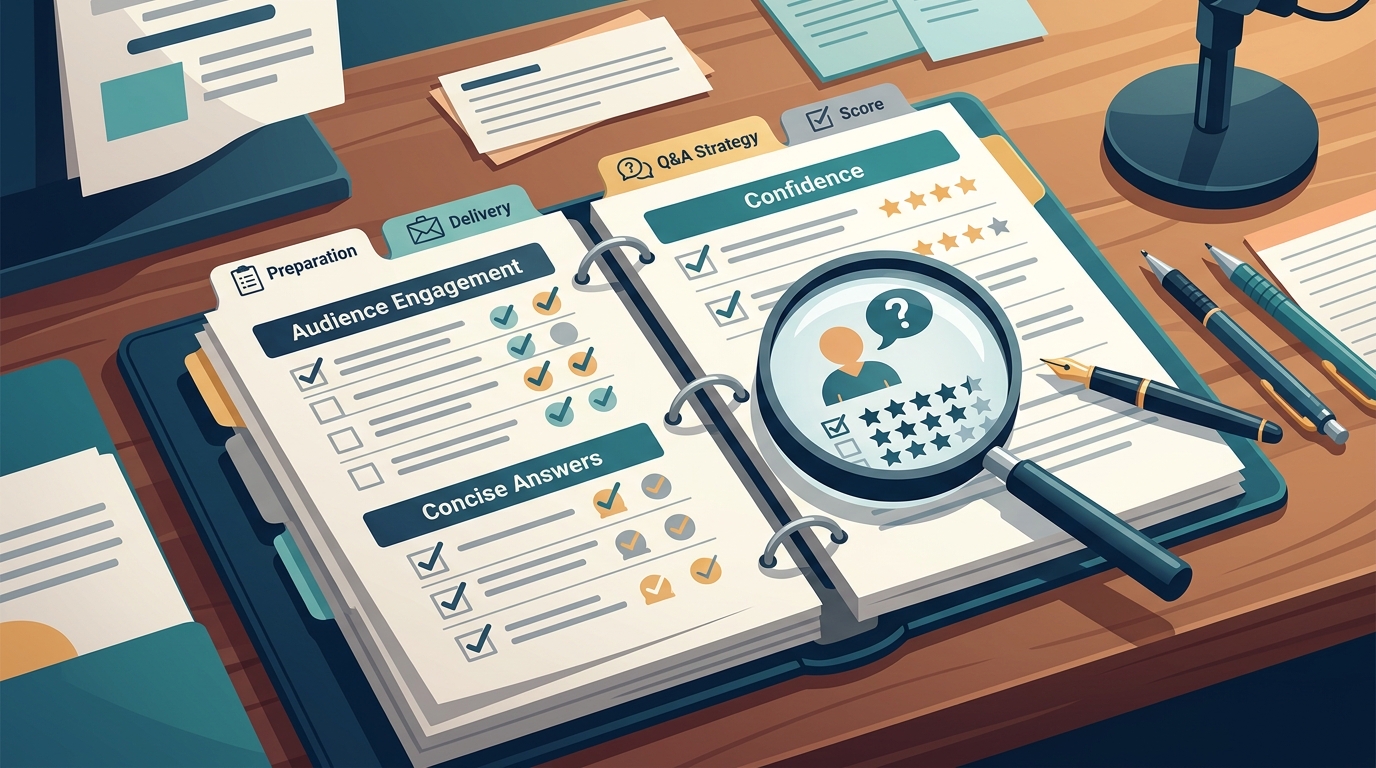
To objectively assess your Q&A handling skills, use the following matrix. Rate yourself on each criterion from 1 to 5, where 1 is needs improvement and 5 is expert level. This self-assessment will help you identify your strongest areas and those requiring immediate attention.
| Criterion | Key Indicator | Self-Rating (1-5) | Improvement Action |
|---|---|---|---|
| Clarity | Direct, concise answers without rambling | Practice the "one-minute rule" | |
| Listening | Full attention before responding | Record and review your sessions | |
| Unknowns | Graceful admission and follow-through | Prepare fallback phrases | |
| Body Language | Open posture and consistent eye contact | Work with a coach on presence | |
| Pivoting | Smooth transition to key messages | Script pivot points in advance |
Key Takeaways
- Clarity and conciseness are the primary drivers of perceived authority during Q&A sessions.
- Active listening and validation build trust and disarm potential hostility from the audience.
- Handling the unknown with integrity is more valuable than bluffing your way through a question.
- Non-verbal cues such as posture and eye contact significantly impact how your answers are received.
- Strategic pivoting allows you to maintain control of the narrative while respecting the inquiry.
- Effective Presentations has trained over 100,000 individuals to master these communication skills.
- Regular self-assessment using a structured matrix is essential for continuous improvement.
Frequently Asked Questions
How can I reduce filler words during Q&A?
Filler words often stem from nervousness or a lack of preparation. Pausing intentionally gives your brain time to formulate the next sentence. Practicing with a timer can also help you become more comfortable with silence.
What is the best way to handle a hostile question?
Stay calm and professional. Acknowledge the emotion behind the question without adopting it. Reframe the question to focus on the underlying issue rather than the tone. This de-escalates the situation and keeps the conversation productive.
How long should a Q&A session last?
The duration depends on the total presentation time. A common rule of thumb is to allocate 10-20% of the total time for Q&A. However, it is better to end on a high note than to drag out the session unnecessarily.
Can I use notes during Q&A?
Yes, but sparingly. Having key data points or follow-up promises written down can be helpful. However, relying too heavily on notes can break your connection with the audience. Use them as a reference, not a script.
What if I don't know the answer to a question?
Admit it honestly. Offer to follow up with the correct information later. This demonstrates integrity and reliability. Never guess or provide inaccurate information.
How do I keep the audience engaged during Q&A?
Encourage interaction by inviting questions early. Use open-ended prompts to stimulate discussion. Maintain eye contact and vary your vocal delivery to keep the energy high.
Is it okay to repeat a question before answering?
Yes, especially in large rooms. Repeating the question ensures that everyone hears it and gives you a moment to think. It also clarifies the topic for the audience.
Next Steps
Evaluating your Q&A handling skills is the first step toward becoming a more influential communicator. However, true mastery requires practice and feedback. Effective Presentations offers tailored training programs designed to help you refine these essential criteria. Whether you are an individual looking to boost your confidence or a team seeking to enhance your collective impact, our experts are here to guide you.
Take the next step in your professional development. Visit our Consulting and Partnership Program page to learn more about our corporate training solutions. Or, schedule a free consultation to discuss your specific needs. Remember, the ability to handle questions with grace and authority is a skill that can be learned. Let us help you unlock your full potential.