

Presentation Skills Courses for Beginners: How to Build Real Confidence
If you have ever felt your heart race before a meeting or stumbled through a team update, you are not alone. Research shows that 75% of people experience some level of public speaking anxiety, and only about 25% of presenters actually feel confident in their abilities. The good news is that presentation confidence is not a personality trait; it is a trainable skill. The right beginner course can close that gap faster than most professionals expect. This guide breaks down what to look for, what types of courses exist, and how to choose one that turns nervous energy into genuine poise.
Why Presentation Confidence Matters for Your Career
Presentation confidence is the ability to deliver your message clearly and calmly under real business pressure. It is not about being fearless; it is about performing well even when nerves are present.
The career data is hard to ignore. According to Novoresume research, employees who are confident public speakers are 70% more likely to be promoted to management roles. The same data shows that public speaking training can boost annual salary by roughly 10%.
Meanwhile, 90% of professionals say strong presentation skills are crucial for success, yet only a quarter feel confident delivering them. That gap represents a massive opportunity for any beginner willing to invest in structured training.
Types of Presentation Skills Courses for Beginners
In-Person Workshops
In-person workshops place you in a room with a trainer and a small group. You present multiple times, receive direct coaching, and adjust in real time. Presentation skills training workshops from Effective Presentations, for example, are built for professionals who present in meetings, pitches, and leadership settings and want more confidence, clarity, and influence.
Live Virtual Training
Live virtual training is instructor-led coaching delivered over video platforms like Zoom. It is not a recorded webinar or a self-paced module. Live online presentation skills training lets you sharpen your skills without travel or downtime while still getting real-time feedback from certified trainers.
Short-Form Masterclasses
Masterclasses are laser-focused sessions, typically one to two hours, that target a single skill such as storytelling, body language, or vocal variety. These interactive corporate communication courses work well for teams that need a quick skill boost without committing to a full-day program.
What to Look for in a Beginner Course
Not every course labeled "beginner-friendly" actually builds lasting skill. Here is what separates effective programs from time-wasters:
- Coached practice rounds: You should present and receive specific behavioral feedback, not just general encouragement.
- Small group sizes: Look for groups of 10 or fewer so each participant gets meaningful coaching time.
- Certified trainers: Instructors should be nationally certified communication experts, not just motivational speakers.
- Practical focus: The best courses use your actual work presentations, not hypothetical exercises.
- Proven track record: Effective Presentations, for instance, has over 20 years of experience and more than 100,000 professionals trained with over 1,200 five-star reviews.
Course Format Comparison Table
| Format | Duration | Best For | Live Coaching | Travel Required |
|---|---|---|---|---|
| In-Person Workshop | 1-3 days | Deep skill building | Yes | Yes |
| Live Virtual Training | Half-day to 2 days | Remote or hybrid teams | Yes | No |
| Masterclass | 1-2 hours | Single-skill focus | Yes | No |
| 1-on-1 Coaching | Flexible | High-stakes prep | Yes | No |
| Self-Paced Online Course | Varies | Information only | No | No |
Self-paced online courses explain concepts well but lack the live practice and real-time coaching that produce behavioral change. If your goal is real confidence, prioritize formats with a coached practice loop.
Core Skills Every Beginner Course Should Cover
Message Structure
A well-structured message is the foundation of every effective presentation. Beginners should learn how to open strong, organize key points clearly, and close with a specific call to action. Explore how messaging and structure training builds this skill from the ground up.
Delivery Mechanics
Delivery mechanics include eye contact, gestures, vocal variety, and the elimination of filler words. These are the nonverbal signals that communicate confidence before you even finish your first sentence. Studies show that non-verbal cues account for 55% of your communication impact.
Managing Nerves
Anxiety management is not about removing nervousness entirely. It is about redirecting that energy into purposeful delivery. Research confirms that 90% of speaking anxiety stems from lack of preparation, which is why practice-based training is the most effective remedy.
Why Coached Practice Beats Passive Learning
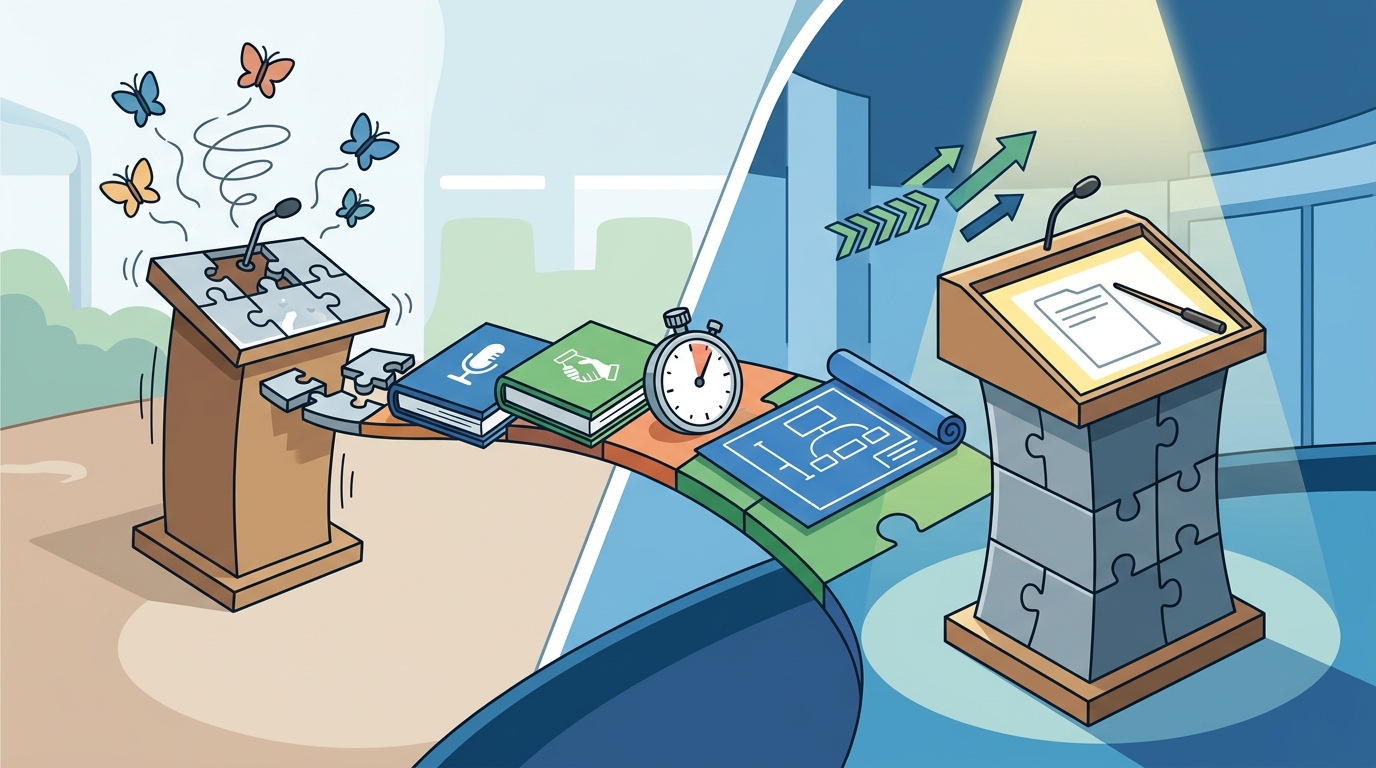
There is a critical difference between understanding presentation concepts and actually performing under pressure. The most effective beginner programs use a cycle of skill introduction, live practice, direct coaching, and a second attempt.
Business presentation training at Effective Presentations follows exactly this model. Participants present their actual work material, receive targeted feedback, and present again. By the end of the session, the skill has been practiced enough to transfer back to the job.
This approach mirrors how confidence actually forms. You do not think your way into confidence; you practice your way into it. Each coached repetition shrinks the gap between what you know and what you can reliably do when the stakes are real.
Key Takeaways
- 75% of people experience public speaking anxiety, but confidence is a trainable skill, not a fixed trait.
- Confident speakers are 70% more likely to be promoted and can earn roughly 10% more annually.
- The best beginner courses use coached practice with real-time feedback, not lectures or self-paced videos.
- In-person workshops, live virtual sessions, and focused masterclasses each serve different needs and schedules.
- Core skills for beginners include message structure, delivery mechanics, and nerve management.
- Small group sizes and certified trainers are non-negotiable quality indicators.
- Effective Presentations has trained over 100,000 professionals across 20+ years with consistently top-rated results.
Frequently Asked Questions
What is a presentation skills course?
A presentation skills course is a structured training program that teaches you how to organize your message, deliver it with confidence, and engage your audience in business or professional settings.
Are presentation skills courses worth it for complete beginners?
Absolutely. Beginners often see the most dramatic improvement because they start with the largest gap between potential and performance. Coached practice produces visible results even in a single session.
How long does it take to build presentation confidence?
Most professionals notice a measurable shift after a focused two-day workshop. Ongoing improvement comes from applying learned techniques in real meetings and follow-up coaching sessions like 1-on-1 private coaching.
Can I take a presentation course online?
Yes. Live virtual training programs deliver the same coached practice model as in-person workshops. The key distinction is that the session must be instructor-led and interactive, not a pre-recorded video library.
What is the difference between a presentation course and a public speaking course?
Public speaking training focuses primarily on platform delivery to larger audiences. Public speaking training and presentation courses overlap significantly, but presentation courses also emphasize message construction, slide strategy, and business context.
How much does a beginner presentation skills course cost?
Costs range from free webinars with limited value to multi-thousand-dollar executive coaching programs. Mid-range in-person workshops and live virtual sessions typically offer the best return on investment for beginners because they include real coaching time.
What should I prepare before attending a presentation course?
Bring a real presentation or topic you need to deliver at work. The best programs have you practice with your actual material so the skills transfer immediately to your job.
How do I know if a course is right for my skill level?
Look for programs that assess your starting point before the session. Effective Presentations, for example, contacts each participant before training to understand their goals and ensure the experience is tailored to their needs.
Start Building Your Presentation Confidence Today
The gap between wanting to be a better presenter and actually becoming one is smaller than you think. It starts with one decision: choose a course that puts you on your feet, gives you honest feedback, and helps you practice until the skill sticks. Explore individual training options at Effective Presentations and take the first step toward presenting with clarity, confidence, and credibility.