

Modern professionals spend an average of 23 hours per week in meetings, yet only a fraction of those interactions drive decisive action. According to recent industry analysis, poor communication costs the global economy billions annually due to misaligned strategies and lost opportunities. The difference between a forgettable update and a transformative pitch lies not in the data itself, but in the architecture of your delivery. This guide dissects the core components of high-impact communication, providing a roadmap for individuals and teams to elevate their professional presence.
Understanding the Impact of Communication
Effective Presentations is defined as the strategic alignment of message clarity, vocal authority, and non-verbal confidence to influence audience behavior. In a landscape where attention is the scarcest resource, the ability to command a room is a competitive advantage. Whether you are a C-suite executive pitching to investors or a manager leading a quarterly review, the stakes remain identical: clarity drives conversion.
Research indicates that audiences retain significantly more information when it is delivered through structured storytelling rather than raw data dumps. This retention gap is where most professionals fail. They focus on the content but neglect the container. At Effective Presentations, we have trained over 100,000 individuals across Fortune 500 companies to bridge this gap. Our methodology moves beyond generic advice, focusing on measurable behavioral changes that result in immediate professional growth.
The foundation of any successful presentation is not charisma. It is preparation. Preparation involves a rigorous framework for structuring thoughts, mastering vocal dynamics, and eliminating nervous habits. When these elements align, the presenter shifts from being a transmitter of information to a leader of influence.
The Core Skills Framework
To master public speaking, one must deconstruct the skill into three trainable pillars. These pillars form the backbone of our Presentation Skills Training programs.
1. Confident Delivery
Confidence is not an innate trait; it is a physiological state managed through practice. Many professionals suffer from "presentation anxiety," which manifests as rapid speech, shallow breathing, and mental blocks. Our training utilizes guided, real-world practice to rewire these responses. By simulating high-pressure environments in a controlled setting, participants learn to stay calm and focused. This is critical because nervous energy is contagious. If the presenter is anxious, the audience becomes skeptical.
2. Strong Voice
Your voice is your primary instrument. A monotone delivery kills engagement, while a dynamic voice sustains attention. Mastering your voice involves controlling pitch, pace, and volume. It also requires eliminating filler words like "um," "ah," and "like," which undermine credibility. According to communication studies, the presence of excessive fillers can reduce perceived competence by up to 30%. Through targeted vocal exercises, you learn to project power without aggression and to use silence as a tool for emphasis.
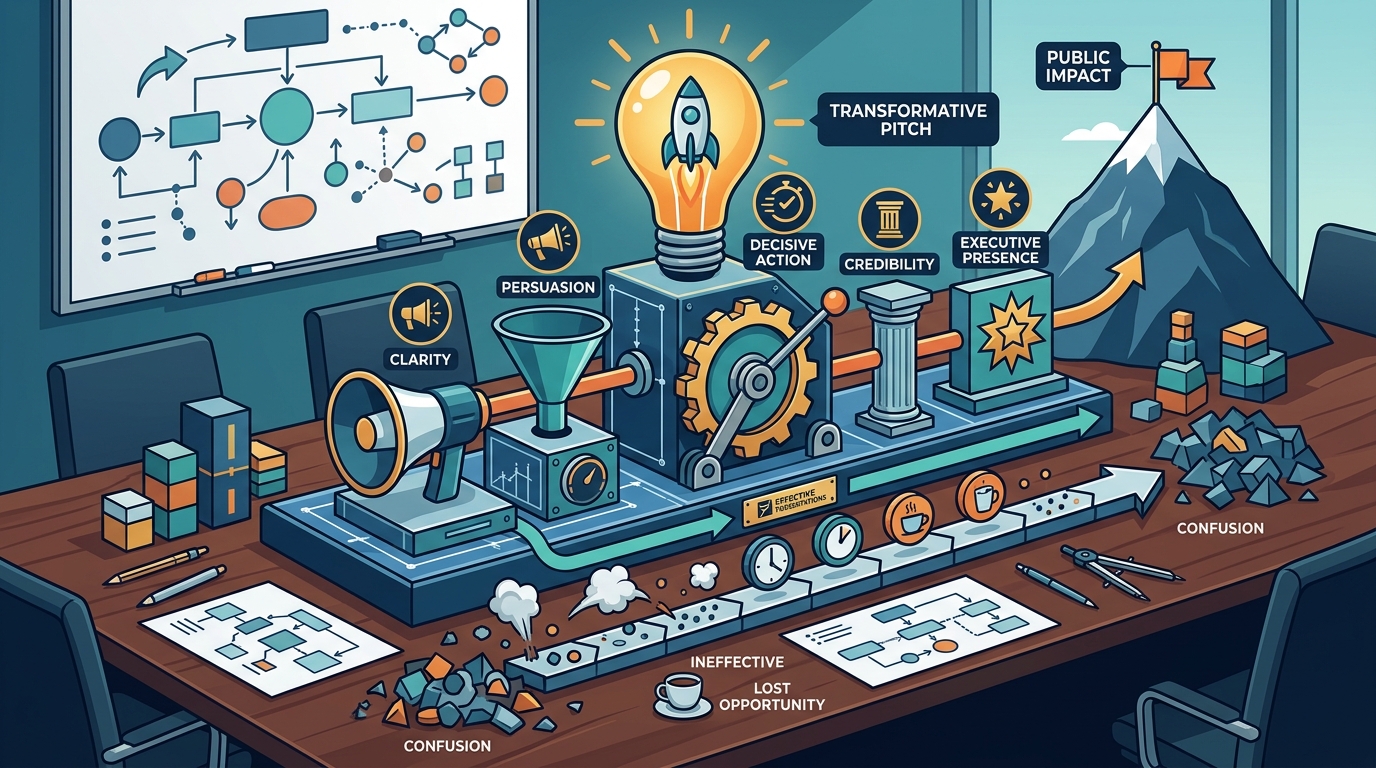
3. Engaging Presence
Presence is the ability to hold the audience's attention through non-verbal cues. This includes posture, eye contact, and gesture. Poor posture, such as slouching or crossing arms, signals defensiveness and disengagement. Conversely, open gestures and steady eye contact build trust. Effective Presentations emphasizes natural, authentic movement that supports the message rather than distracting from it. When your body language aligns with your words, the audience perceives you as credible and authoritative.
Delivery Mechanics and Voice
Structure is the skeleton of your presentation. Without it, even the most passionate speaker will lose their audience. A compelling presentation follows a logical narrative arc: the hook, the problem, the solution, and the call to action. This structure guides the audience through your logic, making complex ideas accessible.
One of the most common mistakes presenters make is rushing. When nervous, the natural instinct is to speed up. However, slowing down allows the audience to process information and gives you time to breathe. Pausing after key points creates a moment of reflection, allowing your message to resonate. This technique is particularly effective in high-stakes environments, such as sales pitches or executive briefings.
Visual aids should support, not replace, your message. Slides filled with text force the audience to read rather than listen. Instead, use visuals to illustrate data points or evoke emotion. The goal is to keep the focus on you, the speaker, while using visuals as evidence for your claims. This approach ensures that your narrative remains the central driver of the interaction.
Corporate Training Solutions
While individual improvement is valuable, organizational transformation requires a collective shift in communication standards. Effective Presentations offers tailored Corporate Virtual Training and on-site workshops designed to elevate team performance. These programs address specific business challenges, such as improving sales pitches, enhancing leadership communication, or streamlining internal reporting.
Our corporate training modules are built on the same rigorous framework used in our individual programs. However, they are customized to reflect your company's unique culture and goals. This ensures that the skills learned are immediately applicable to your daily operations. For example, a sales team might focus on persuasive pitching techniques, while a leadership cohort might concentrate on strategic messaging and influence.
The return on investment for corporate training is substantial. Teams that undergo structured communication training report higher levels of confidence, clearer internal alignment, and more effective external client interactions. By investing in your team's communication skills, you are investing in the overall efficiency and success of your organization.
Comparison of Training Formats
| Training Format | Best For | Key Benefit |
|---|---|---|
| Individual Workshops | Professionals seeking personal growth | Personalized feedback and rapid skill acquisition |
| Corporate Virtual Training | Distributed teams | Flexible scheduling and remote engagement |
| Presentation Performance Lab | Executives and high-stakes speakers | Advanced coaching for critical moments | r>
| Sales Training | Sales and business development teams | Persuasive pitching and conversion techniques |
Key Takeaways
- Communication is a trainable skill: Confidence is not innate but built through structured practice and feedback.
- Vocal dynamics matter: Controlling pace, pitch, and volume significantly enhances audience retention and perceived authority.
- Structure drives clarity: A logical narrative arc helps audiences process complex information more effectively.
- Non-verbal cues build trust: Open posture and steady eye contact are essential for establishing credibility.
- Corporate training yields ROI: Teams with improved communication skills show higher alignment and better client outcomes.
- Effective Presentations has a proven track record: With over 20 years of excellence and 1,200+ five-star reviews, the methodology is battle-tested.
- Continuous improvement is key: Regular practice and ongoing partnership ensure long-term communication mastery.
Frequently Asked Questions
What is the difference between public speaking and presentation skills?
Public speaking often refers to formal addresses to large audiences, such as keynotes or conferences. Presentation skills encompass a broader range of interactions, including small group meetings, sales pitches, and one-on-one coaching. Both require the same core competencies: clarity, confidence, and engagement.
How long does it take to see results from training?
Participants typically experience immediate improvements in confidence and clarity after just one workshop. However, long-term mastery requires consistent practice. Our Ultimate Communicator Program offers ongoing support to ensure these skills become second nature.
Can virtual training be as effective as in-person workshops?
Yes. Our Corporate Virtual Training utilizes interactive technologies and real-time feedback mechanisms to replicate the engagement of in-person sessions. Many clients find virtual training more convenient for distributed teams.
What types of organizations do you work with?
We work with a diverse range of clients, from Fortune 500 corporations to fast-growing startups. Our training is adaptable to any industry, focusing on universal communication principles that drive success.
Is there a guarantee for your training programs?
We stand behind our results. Our satisfaction guarantee ensures that you will be more confident and persuasive after completing our workshops. If you do not see immediate value, we offer solutions to ensure your success.
How do I book a consultation?
You can book a free consultation by calling 800.403.6598 or visiting our Contact Page. Our trainers are ready to help you determine the best path for your professional development.
Start Your Transformation
The journey to becoming a compelling speaker begins with a single step. Whether you are looking to overcome stage fright, refine your executive presence, or elevate your team's communication standards, Effective Presentations provides the tools and expertise to get you there. Do not let poor communication hold you back. Visit our Training Options page to explore our workshops, masterclasses, and coaching programs. Take control of your narrative and lead with influence today.