
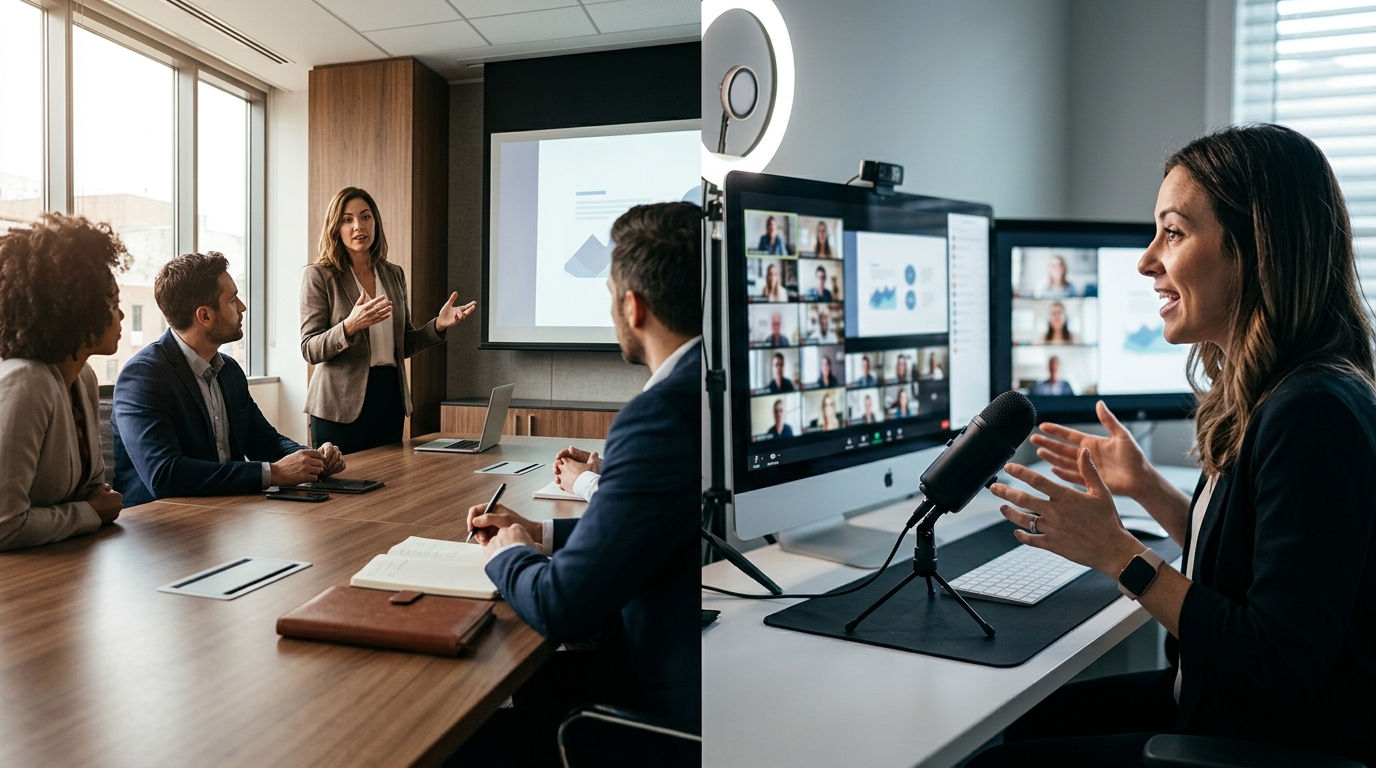
Live vs. Virtual Presentation Training: Which Delivers Better Results?
Research indicates that 75% of corporate learning budgets have shifted toward hybrid or virtual models in recent years, yet the debate over efficacy remains intense. When it comes to high-stakes communication skills, the medium of instruction fundamentally alters the learning curve. Effective Presentations has spent over 20 years mastering both delivery methods, serving more than 1,200 clients who demand measurable improvements in their public speaking abilities. This analysis breaks down the critical differences between in-person workshops and live virtual training to help you choose the right path for your professional growth. (About Effective Presentations 20)
Core Differences in Learning Dynamics
Understanding the distinction between these two formats requires looking at how feedback is delivered and consumed. Live training relies on physical presence, allowing trainers to read body language and adjust pacing in real-time based on room energy. Virtual training utilizes digital platforms to create interactive sessions that require different engagement strategies. The fundamental goal remains the same: to transform nervous speakers into confident communicators. However, the mechanisms for achieving this transformation vary significantly. (Effective Presentations Presentation amp)
Effective Presentations defines presentation skills as the ability to structure, deliver, and influence an audience with clarity and confidence. Whether delivered via a projector in a conference room or a webcam in a home office, the core curriculum focuses on three pillars: confident delivery, strong voice, and engaging presence. The choice between live and virtual often comes down to logistical constraints and individual learning preferences. (Our Blog Effective Presentations)
The Case for In-Person Workshops
In-person workshops offer an immersive environment that is difficult to replicate digitally. Participants are removed from their daily distractions, allowing for deep focus on skill acquisition. This format is particularly effective for overcoming stage fright because the physical act of standing in front of an audience is simulated in a safe, controlled setting. (Effective Presentations Valued Clients)
Immediate, Multi-Sensory Feedback
One of the primary advantages of live training is the immediacy of feedback. Trainers can correct posture, eye contact, and vocal projection instantly. According to industry data on skill retention, hands-on practice with immediate correction leads to faster mastery than passive learning. In a live workshop, you are filmed and coached, allowing you to see exactly how you come across to others. This visual feedback loop is critical for identifying unconscious habits like filler words or nervous gestures.
Networking and Peer Learning
Live workshops facilitate organic networking among peers. Participants often report that the collaborative aspect of group exercises is just as valuable as the instruction itself. Building trust through effective eye contact and shared vulnerability creates a supportive community. This dynamic is harder to achieve in a virtual setting where participants are often isolated in their own physical spaces.
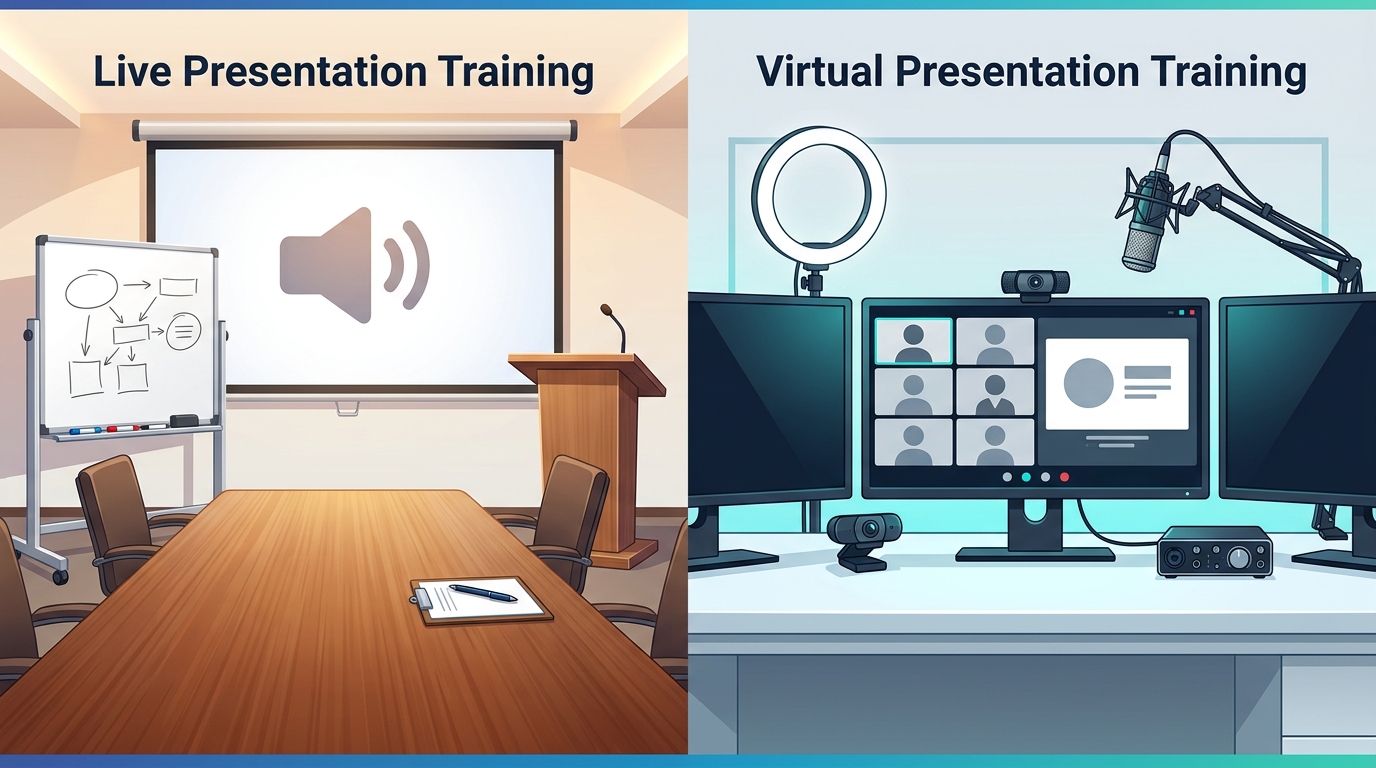
The Power of Live Virtual Training
Live virtual training has evolved from a pandemic necessity to a strategic advantage for global organizations. It offers flexibility and accessibility that in-person events cannot match. For teams spread across different time zones or regions, virtual training eliminates travel costs and logistical nightmares.
Scalability and Accessibility
Virtual training allows organizations to scale communication skills development across entire enterprises without the need for multiple workshop dates. Corporate virtual training enables interactive team training from anywhere, ensuring consistent messaging and skill levels across all locations. This is particularly important for companies with remote workforces who need to maintain high standards of professional communication.
Real-World Application
Interestingly, virtual training can be more relevant for modern professionals who frequently present via video conferencing. By practicing in the same environment they will use for work, participants build comfort with the technology itself. This reduces anxiety associated with technical glitches and camera presence. Effective Presentations offers specialized Media & On-Camera Training to prepare leaders for interviews and on-camera appearances, leveraging the virtual format to simulate real-world scenarios.
Comparative Analysis of Outcomes
Choosing between live and virtual training depends on your specific goals, budget, and team dynamics. The following table summarizes the key differences to aid in your decision-making process.
| Feature | Live In-Person Workshop | Live Virtual Training |
|---|---|---|
| Feedback Quality | High (Multi-sensory, physical cues) | High (Digital tools, screen sharing) |
| Distraction Level | Low (Dedicated environment) | Variable (Home/Office context) |
| Cost Efficiency | Higher (Travel, venue, meals) | Lower (No travel, digital delivery) |
| Networking | Strong (Organic interaction) | Moderate (Structured breakout rooms) |
| Best For | Executive coaching, high-stakes pitches | Global teams, routine skill building |
For high-stakes scenarios, such as Pitch & RFP Partnership training, the intensity of live interaction is often preferred. However, for ongoing skill maintenance, virtual masterclasses provide bite-sized, high-impact sessions that fit into busy schedules. Both formats are backed by the same expert trainers and proven methodologies.
Key Takeaways
- Experience Matters: Effective Presentations has over 20 years of training excellence, ensuring both live and virtual formats are delivered by expert coaches.
- Proven Results: Over 1,200 five-star reviews attest to the effectiveness of their transformation programs, regardless of delivery method.
- Customization: Training can be tailored for individuals, teams, or C-suite executives, with specific focus on messaging and structure.
- Flexibility: Live virtual workshops allow for interactive team training from anywhere, breaking down geographical barriers.
- Depth of Coaching: The Ultimate Communicator Program offers immersive transformation, available in both 1-on-1 and group settings.
- Global Reach: Training hubs in cities like Atlanta, Chicago, and Seattle demonstrate the ability to serve diverse markets.
- Technology Integration: Modern virtual training includes on-camera preparation, essential for today's remote-first business environment.
Frequently Asked Questions
Which is better for overcoming public speaking anxiety?
Live in-person workshops are often more effective for severe anxiety because they provide a safe, physical environment to practice facing an audience. The immediate support of peers and trainers helps build confidence rapidly. However, virtual training can also be beneficial for those who are more comfortable in their own space initially.
Can virtual training provide the same level of feedback as live training?
Yes, live virtual training utilizes advanced digital tools to provide real-time feedback on vocal projection, eye contact, and body language. While the physical cues are different, the core principles of communication remain the same. Effective Presentations ensures that virtual sessions are highly interactive to maintain engagement.
What is the cost difference between live and virtual training?
Virtual training is generally more cost-effective due to the elimination of travel, venue, and meal expenses. However, the investment in high-quality instruction remains consistent. Organizations often find that the scalability of virtual training offers a better return on investment for large teams.
Do you offer hybrid options for training?
While distinct live and virtual formats are offered, many corporate clients combine both. For example, a company might use live workshops for executive coaching and virtual masterclasses for broader team skill building. This hybrid approach maximizes the benefits of each method.
How long are the virtual training sessions?
Virtual sessions are typically structured in focused blocks, such as one-hour masterclasses or half-day workshops. This design ensures that participants remain engaged without experiencing virtual fatigue. The content is condensed to deliver high-impact learning in a shorter timeframe.
Is the training certified or accredited?
Effective Presentations provides results-driven training programs that are recognized for their practical application and measurable outcomes. While specific accreditation may vary by industry, the methodology is grounded in decades of research and practice in communication skills.
Can I switch from virtual to live training later?
Absolutely. Many clients start with virtual training to build foundational skills and then transition to live workshops for advanced coaching. The skills learned in one format are transferable to the other, creating a comprehensive communication development plan.
Next Steps
Whether you choose the immersive power of a live workshop or the flexibility of virtual training, the goal is the same: to speak with confidence and lead with influence. Effective Presentations offers a free consultation to help you determine the best path for your needs. Contact us today to explore our training options and start your journey toward communication excellence.