

Effective Presentations vs. Traditional Seminars: Which Training Model Delivers Real Results?
Public speaking anxiety affects a significant portion of the professional workforce, yet traditional large-scale seminars often fail to provide the personalized feedback necessary to overcome it. According to industry data, over 75% of people experience some form of glossophobia, making effective communication a critical career skill. This statistic highlights why the debate between intensive, small-group coaching and massive, passive seminars is so relevant for professionals seeking genuine improvement.
Core Differences in Training Methodology
The fundamental distinction lies in the level of individual attention. Traditional seminars often prioritize scale, bringing hundreds of attendees together for a one-way delivery of information. In contrast, specialized training programs focus on active participation and immediate correction. This approach ensures that every participant receives tailored feedback on their specific delivery style, vocal patterns, and body language.
Effective Presentations operates on a model that rejects the "mass seminar" format. Instead, they offer small-group workshops limited to ten seats. This constraint is not arbitrary. It allows trainers to provide real-time coaching and video analysis, which are critical for identifying unconscious habits like filler words or nervous pacing. The goal is transformation, not just information transfer.
Another key difference is the duration and depth of engagement. While a typical seminar might last a few hours or a single day, comprehensive training programs often span multiple days or include ongoing partnership options. This extended timeline allows for the gradual building of confidence and the refinement of complex communication strategies. The blog on the Effective Presentations website often details how these incremental improvements lead to long-term professional growth.
Measuring Training Effectiveness
How do you determine which method works best? The answer lies in the metrics of confidence and clarity. Traditional seminars often rely on post-event surveys that measure satisfaction rather than skill acquisition. Participants may leave feeling inspired but without the practical tools to implement changes in their daily work.
Small-group training, however, uses a structured framework for assessment. Participants are filmed during practice sessions and reviewed with their trainers. This visual feedback loop is powerful. It allows individuals to see exactly how they come across to an audience, bridging the gap between self-perception and reality. This method is particularly effective for executives and leaders who need to communicate with precision and authority.
Research in communication skills training suggests that active practice yields higher retention rates than passive listening. A study by the National Training Laboratories indicates that people remember 75% of what they do, compared to only 5% of what they read. This principle underscores the value of hands-on workshop environments where participants deliver actual presentations and receive immediate critique.
Cost Analysis and ROI
Investment in professional development varies widely. Traditional seminars can range from free events to several hundred dollars per attendee. While the upfront cost may seem lower, the return on investment (ROI) is often diluted by the lack of personalized support. You pay for the seat, but not for the specific guidance you need to improve.
Specialized workshops like those offered by Effective Presentations have a higher initial price point. For example, the Orange County Presenting With Impact Workshop is priced at $1,795 for two days of intensive training. However, this cost includes lunch, individual coaching, and video analysis. When viewed as an investment in career advancement, the ROI becomes clear. Improved presentation skills can lead to better client outcomes, stronger leadership presence, and increased revenue generation.
Corporate clients often find that team-based training offers even greater value. By elevating the communication skills of an entire department, organizations see measurable improvements in pitch success rates and internal alignment. The client list includes Fortune 500 companies and fast-growing startups, demonstrating the broad applicability of this high-touch training model.
The Workshop Advantage
Workshops provide a unique environment for skill acquisition. They are designed to be immersive, with participants spending the majority of their time practicing rather than listening. This structure accelerates learning and builds confidence quickly. The limited seat count ensures that every participant gets ample opportunity to speak and receive feedback.
One of the most significant advantages is the networking aspect. In a small group, participants form connections with peers who are also striving for improvement. This creates a supportive community that extends beyond the workshop itself. Many alumni of these programs continue to support each other through online communities and follow-up sessions.
The curriculum is also highly adaptable. Trainers can tailor content to address specific challenges, such as sales pitches, executive briefings, or media interviews. This flexibility ensures that the training is relevant to the participant's immediate needs. The case studies on the Effective Presentations site highlight real-world transformations achieved through this targeted approach.
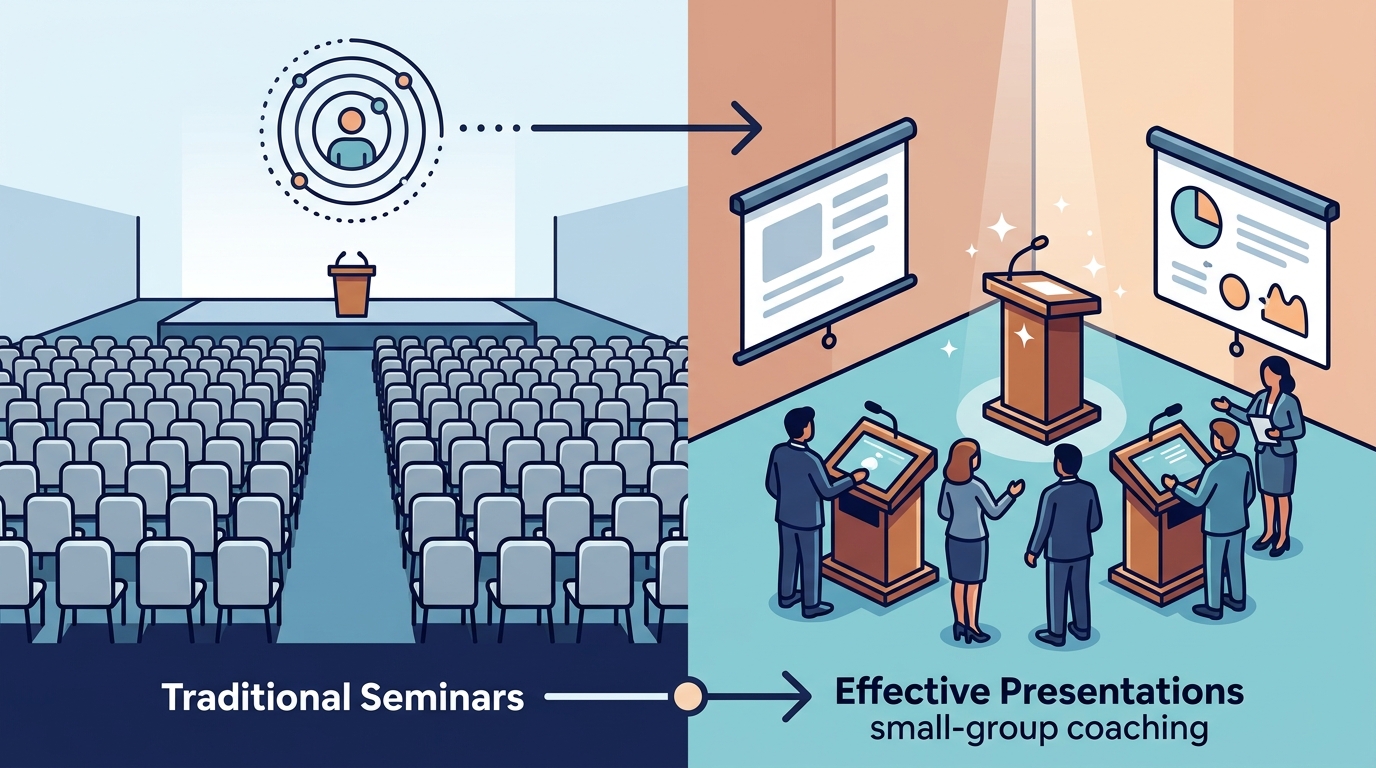
Detailed Comparison Matrix
| Feature | Traditional Seminars | Effective Presentations Workshops |
|---|---|---|
| Group Size | Large (100+ attendees) | Small (Max 10 seats) |
| Feedback Type | Generic or None | Real-time, Individual Coaching |
| Practice Time | Minimal | Extensive, Guided Practice |
| Video Analysis | Not Available | Included in Training |
| Cost Range | $0 - $500 | $1,795 (2-Day Workshop) |
| Outcome Focus | Inspiration | Transformation & Skill Mastery |
Key Takeaways
- Small-group workshops provide significantly more individual attention than large seminars.
- Video analysis is a critical tool for identifying and correcting unconscious communication habits.
- Effective Presentations has over 20 years of training excellence and 1,200+ five-star reviews.
- The ROI of specialized training often outweighs the lower upfront cost of generic seminars.
- Corporate training options are available for teams seeking to elevate their collective communication skills.
- Limited seat counts ensure a high-quality, immersive learning environment.
- Trusted by Fortune 500 companies, the methodology is proven for high-stakes environments.
Frequently Asked Questions
Who is the Effective Presentations workshop for?
The workshop is designed for anyone who needs to present ideas clearly and confidently. This includes executives, sales professionals, entrepreneurs, and anyone seeking to improve their public speaking skills. The small group size ensures that content is relevant to all skill levels.
How does the cost compare to other training options?
While the upfront cost is higher than a typical seminar, the value is derived from the personalized coaching and video feedback. Traditional seminars often lack the mechanisms for individual improvement, making the specialized workshop a more effective investment for serious skill development.
Is there a guarantee for the training?
Effective Presentations stands behind their results with a satisfaction guarantee. They promise that participants will be more confident and persuasive after the training. This commitment reflects their confidence in the methodology and the expertise of their trainers.
What is the format of the workshop?
The workshop is intensive and hands-on. It typically spans two days, with participants delivering presentations and receiving immediate feedback. The format is designed to be immersive, with minimal lecture time and maximum practice time.
Can I attend the workshop virtually?
While the core transformational workshops are in-person to allow for video analysis and peer interaction, Effective Presentations also offers corporate virtual training options. These are tailored for teams and focus on specific communication challenges in a digital environment.
How do I book a consultation?
You can book a free consultation by calling 800.403.6598 or by using the contact form on the Effective Presentations website. Trainers are available to discuss your specific needs and recommend the best training path.
What makes Effective Presentations different from other trainers?
The difference lies in the focus on individual transformation through small-group coaching. Unlike mass seminars, they prioritize real-time feedback and video analysis. This approach ensures that participants leave with actionable skills, not just inspiration.
Next Steps
Choosing the right training model depends on your goals and commitment to improvement. If you are ready to transform your communication skills, consider joining a specialized workshop. Effective Presentations offers a proven path to confidence and clarity. Visit the Effective Presentations homepage to explore upcoming workshops and schedule your free consultation today.